

Betting odds are the prices attached to possible betting outcomes and determine the potential return on a winning wager. For example, a Canadian bettor who stakes C$25 on the Toronto Maple Leafs at decimal odds of 1.80 would receive a C$45 total return if that selection wins. In other words, what betting odds are is both a payout calculation and a market price: the number 1.80 tells you how much the stake could return and expresses how that outcome is priced relative to the alternatives.
📊 What Does a Betting Odd Actually Tell You?
A betting odd tells you two practical things: the total amount a winning selection could return and the price assigned to that outcome. Understanding betting odds starts with recognising that it is not a guarantee of the result.
With decimal odds, multiply the stake by the odds. A C$20 stake at 2.50 gives a C$50 total return if it wins.
Lower decimal odds usually correspond to a higher implied probability, while higher decimal odds usually correspond to a lower implied probability. In a hypothetical NHL market, Toronto at 1.60 is priced as more likely than Montreal at 2.40. The 1.60 price does not make Toronto certain to win; it only shows that Toronto is offered at a shorter price.
🧮 How to Calculate a Payout From Betting Odds
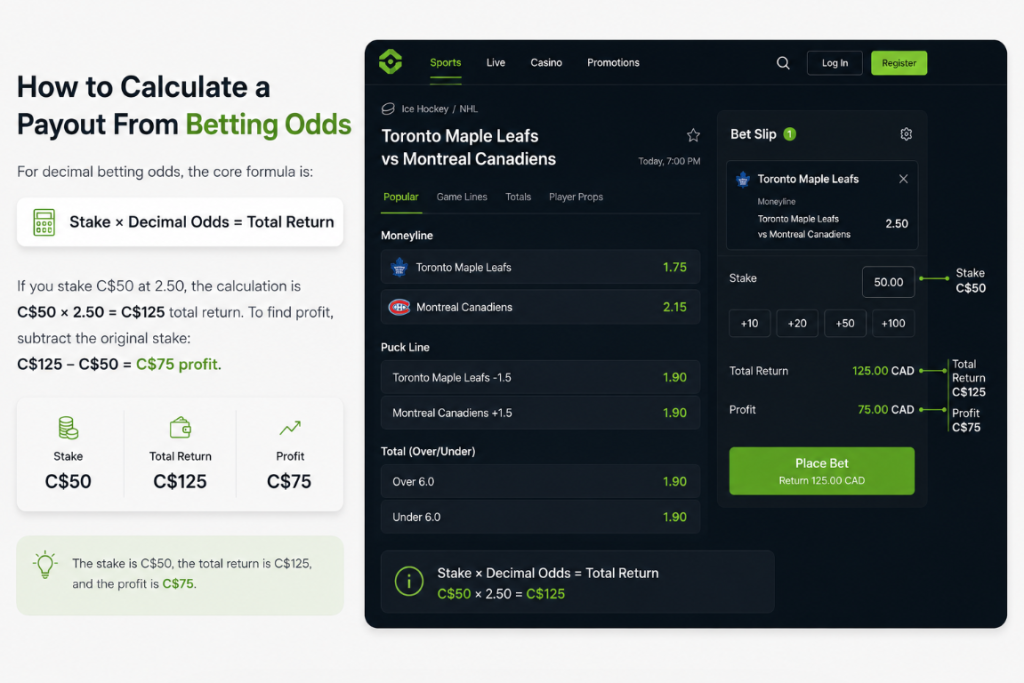
For decimal betting odds, the core formula is:
Stake × Decimal Odds = Total Return
If you stake C$50 at 2.50, the calculation is C$50 × 2.50 = C$125 total return. To find profit, subtract the original stake: C$125 − C$50 = C$75 profit.
The stake is C$50, the total return is C$125, and the profit is C$75. The displayed return normally includes the original stake, so a C$125 return is not C$125 profit.
| Stake | Odds | Total return | Profit |
|---|---|---|---|
| C$10 | 1.50 | C$15 | C$5 |
| C$20 | 2.00 | C$40 | C$20 |
| C$25 | 3.00 | C$75 | C$50 |
🤔 How to Read Decimal Odds
Decimal odds are the clearest format for seeing a potential return per dollar staked. This is how decimal betting odds work: the full number includes the stake in the total return.
A C$10 stake at 1.50 returns C$15 if it wins. At 2.00, the same C$10 returns C$20; at 4.00, it returns C$40. Higher numbers therefore create a larger potential return for the same stake.
For a C$10 stake, 1.50 returns C$15, 2.00 returns C$20, and 4.00 returns C$40 if the selection wins. Higher odds do not mean a better bet; they mean a different price and usually a less likely outcome according to the market.
🎟️ Odds and Implied Probability
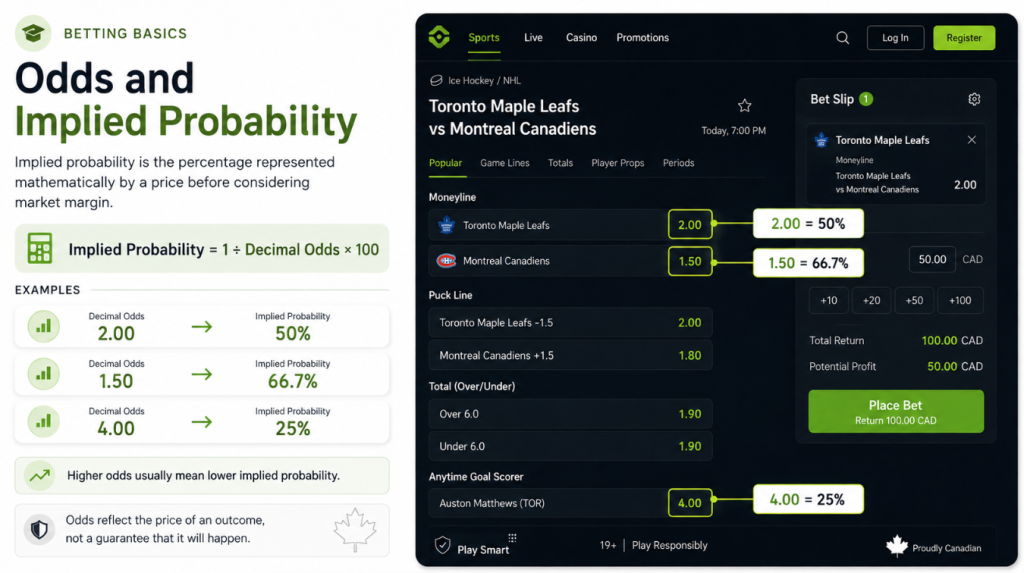
Implied probability is the percentage represented mathematically by a price before considering the market margin. For sports betting odds in decimal format, the beginner formula is:
Implied Probability = 1 ÷ Decimal Odds × 100
For example, 2.00 corresponds to 50%, 1.50 to about 66.7%, and 4.00 to 25%. These figures describe the price; they are not a promise that the event will occur at that rate.
| Decimal odds | Approx. implied probability | ||
|---|---|---|---|
| 1.25 | 80% | ||
| 1.50 | 66.7% | ||
| 2.00 | 50% | ||
| 2.50 | 40% | ||
| 4.00 | 25% |
A bookmaker margin means the implied probabilities for all selections in one market can add up to more than 100%. That is why odds are operator prices rather than pure probabilities.
🎿 A Simple NHL Odds Example
Suppose a bookmaker shows Toronto Maple Leafs at 1.70 and Montreal Canadiens at 2.25 for a hypothetical moneyline market. A C$30 stake on Toronto at 1.70 gives C$30 × 1.70 = C$51 total return if Toronto wins. The profit is C$51 − C$30 = C$21.
The alternative is C$30 on Montreal at 2.25, which would return C$67.50 if Montreal wins. Montreal has the larger potential return because its outcome has been given higher odds; that does not automatically make it more attractive or more likely to win.
🤔 Why Are the Odds Different for Each Team?
Odds differ because each outcome is assessed as having a different likelihood and is given a different price. A bookmaker can use information about team or player strength, recent performance, injuries, home or away context, matchups, and other available information when pricing a market.
Market activity and the bookmaker’s margin can also influence the final prices. The process is not simply a prediction of who will win; it is a way of creating prices for available outcomes and managing a betting market.
👉 Why Do Betting Odds Change?
Betting odds can change before a wager is accepted because the market can receive new information or be reassessed. Injury or lineup news, changing expectations, market movement, betting activity, and the live score or time remaining can all affect the displayed price.
For example, Toronto might open at 2.10 and later move to 1.85. The number shown on a page can change before acceptance, so check the price in the bet slip; the accepted ticket and applicable operator rules determine the terms for that wager.
🤔 What Do + and − Odds Mean?
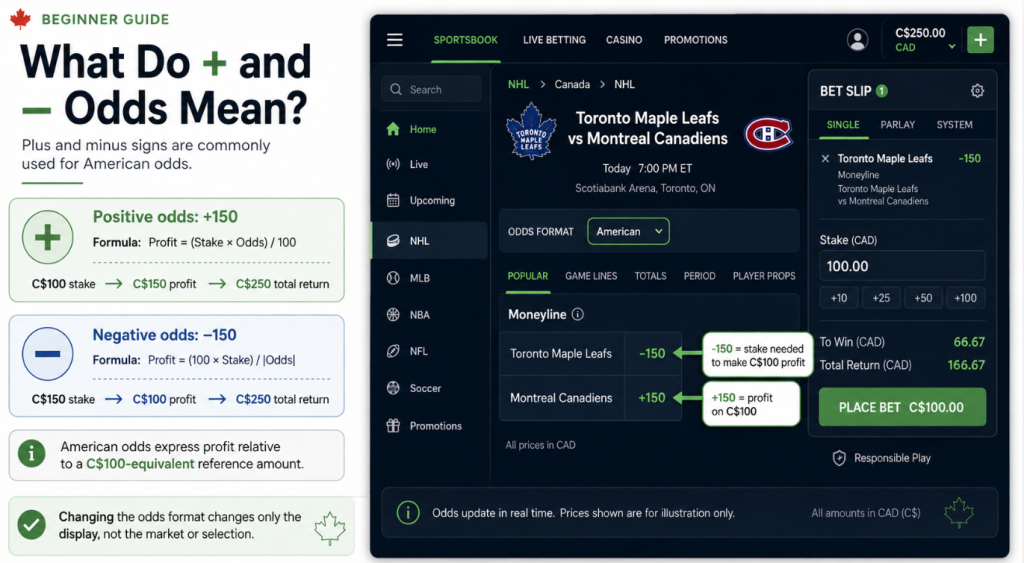
Plus and minus signs are commonly used for American odds. They express potential profit in relation to a C$100-equivalent reference amount rather than showing the full return directly.
▶ Positive odds: +150
Positive odds show the potential profit from a C$100 stake. A C$100 bet at +150 would create C$150 profit plus the C$100 stake, for a C$250 total return if it wins.
▶ Negative odds: −150
Negative odds show how much must be staked to make C$100 profit. A C$150 bet at −150 would create C$100 profit plus the C$150 stake, also producing a C$250 total return if it wins.
Many platforms let users change the displayed odds format. The market and selection stay the same; only the price display changes.
🆚 Decimal Odds vs. American Odds
Decimal and American odds are different ways to express the same price. Decimal is especially useful for quick return calculations because the stake is included in the displayed multiplier.
For reference, 1.50 equals −200 and implies about 66.7%; 2.00 equals +100 and implies 50%; 2.50 equals +150 and implies 40%. Fractional odds, such as 5/2, are another display format associated more often with UK-style betting, not a different kind of wager.
🤔 What Is the Difference Between Odds, a Line, and a Market?
A market is what you are betting on, a line is the number used within some markets, and odds are the price for a particular selection. Separating these terms makes a betting page much easier to read.
For example: the market is Total Goals, the line is 6.5, the selection is Over, and the odds are 1.90. Here, 6.5 is not the odds; it is the line, while 1.90 is the price attached to selecting Over 6.5.
🤩 How Odds Look on a Betting Page
A betting page normally shows the event first, then markets, selections, odds, and the bet slip. Learning how to read betting odds on a page means separating those pieces.
Toronto Maple Leafs vs. Montreal Canadiens
| Market | Selection | Line | Odds |
|---|---|---|---|
| Moneyline | Toronto Maple Leafs | – | 1.75 |
| Moneyline | Montreal Canadiens | – | 2.15 |
| Puck line | Toronto Maple Leafs | -1.5 | 1.95 |
| Puck line | Montreal Canadiens | +1.5 | 1.85 |
| Total goals | Over | 6.0 | 1.90 |
| Total goals | Under | 6.0 | 1.90 |
The event is the game, the market is Moneyline, Puck Line, or Total, and the selection is the chosen outcome. After you tap a selection, the bet slip shows the odds, lets you enter a stake, and calculates a potential return.
🎯 Do Better Odds Mean a Better Bet?
No. Higher odds mean a higher potential return, not necessarily better value or a higher chance of winning. A 5.00 selection pays more than a 1.50 selection for the same stake because the market prices it as substantially less likely.
It helps to keep three ideas separate: payout is the amount that could be returned, implied probability is the percentage represented by the price, and value is a separate judgement about price versus your own assessment. Beginners do not need to calculate expected value to understand that larger numbers are not automatic recommendations.
🤔 Why Two Bookmakers May Show Different Odds
Two betting operators can show different prices for the same team. For example, Operator A may list Toronto at 1.80, while Operator B lists Toronto at 1.85.
This can happen because operators use different pricing and risk models, update at different times, respond differently to market activity, or apply different margins. The point is to understand why numbers differ, not to encourage repeated or impulsive betting.
📝 What Is the Bookmaker Margin in Betting Odds?
The bookmaker margin is the mathematical edge built into a market’s pricing. In a hypothetical two-outcome market with both sides at 1.91, each side represents roughly 52.36% implied probability.
Together, those percentages add to about 104.72%, not 100%. The amount above 100% illustrates the margin. This is why odds should be understood as offered prices rather than as exact, margin-free probabilities.
❓ Common Mistakes Beginners Make When Reading Odds
➜ Mistake 1: Treating return as profit
A C$100 return does not always mean C$100 winnings. If the stake was C$40, then C$60 is the profit and C$40 is the returned stake.
➜ Mistake 2: Thinking higher odds mean better chances
Higher decimal odds normally reflect lower implied probability. They create a larger possible payout for the same stake, but they do not create a stronger likelihood of winning.
➜ Mistake 3: Confusing odds with the spread or total line
An odds number such as 1.90 is a price. A puck line of −1.5 or a total of 6.5 is a condition within a different market.
➜ Mistake 4: Assuming displayed odds cannot change
A displayed price can change before a bet is accepted. Always review the selection, stake, and accepted odds in the bet slip before confirmation.
➜ Mistake 5: Ignoring market rules
Settlement can depend on rules about overtime, player participation, cancellations, and other special conditions. Read the market rules instead of assuming they are identical across every operator.
📝 Quick Betting Odds Cheat Sheet
| If you see… | It means… | ||
|---|---|---|---|
| 1.50 | C$1 returns C$1.50 if the bet wins | ||
| 2.00 | C$1 returns C$2.00 if the bet wins | ||
| 3.00 | C$1 returns C$3.00 if the bet wins | ||
| +150 | A C$100 stake would generate C$150 profit | ||
| −150 | A C$150 stake would generate C$100 profit | ||
| Over 6.5 at 1.90 | 6.5 is the line; 1.90 is the odds | ||
| C$20 at 2.50 | C$50 total potential return |
🛡️ Use Odds Responsibly
Odds can clarify a potential payout, but they do not remove risk or predict a result. Set a spending or time limit, take breaks, and do not chase losses; use available responsible-gambling tools and support if betting stops being enjoyable.
For Ontario, AGCO says sport and event betting operators must meet standards addressing player protection and responsible gambling, while iGaming Ontario provides players with responsible-gambling resources and support links.1 Rules and services vary by location.
❓ FAQ
Betting odds are the prices attached to betting outcomes and show the potential total return if a wager wins. For example, C$20 at decimal odds of 2.00 returns C$40 in total: C$20 is the original stake and C$20 is the profit.
Decimal odds of 2.00 mean that every C$1 staked returns C$2 in total if the selection wins. A C$20 stake at 2.00 therefore has a potential C$40 total return, including the original C$20 stake.
Not automatically. Higher odds create a larger potential return for the same stake, but they usually reflect a lower implied probability according to the market. They are a different price, not a guaranteed better choice or stronger chance of winning.
Decimal odds of 1.50 mean that C$1 returns C$1.50 in total if the bet wins. A C$10 stake would return C$15, made up of the C$10 stake and C$5 profit.
Plus and minus signs are American odds. +150 shows the potential profit from a C$100-equivalent stake, while −150 shows the stake needed to make C$100-equivalent profit. Both describe a price, not a different type of bet.
Multiply the stake by the decimal odds to find the total return. Then subtract the original stake to find profit. For example, C$25 at 3.00 returns C$75 in total, so the profit is C$50.
Odds are the price offered for a selection. Implied probability is the percentage represented mathematically by that price before considering the market margin. Odds are not a pure probability or a guarantee of what will happen.
Prices can change before a bet is accepted. Once accepted, the ticket generally records the accepted price, subject to the relevant market and operator rules. Review the accepted ticket and published terms for the event or market.
Bookmakers can use different pricing models, margins, timing, and market adjustments. As a result, two operators may show different decimal odds for the same team or selection even when they are displaying the same event.



- Casino of games and sports betting
- Generous bonuses and promotions
- Security measures and fair play

- Hundreds of slots, table games
- Welcome bonus and reload bonuses
- Mobile app and mobile website

100% up to C$500
- Groovy bonuses and inducements
- Dedicated VIP program
- Multiple payment methods

100% up to $750 + 200 FS


- Over 4000 casino games
- 25+ sports, with live streaming
- Great range of payment options

100% up to 5 BTC

- Sportsbook with 35+ sports
- Ongoing and reload promotions
- Industry competitive odds


- Library of slots, table games
- Attractive welcome bonuses
- Program with exclusive benefits

Bonus 100% up to C$500
- Extensive game selection
- Welcome bonuses and promotions
- Comprehensive VIP program




Bonus 100% up to C$500
- Games from top-tier providers
- Welcome bonuses and promotions
- Dedicated apps for iOS and Android
Bonus 100% up to C$250
- A vast selection of games
- Attractive bonuses and promotions
- A variety of banking methods


What Is the Legal Betting Age in Canada?
The legal betting age in Canada is 18 or 19 depending on the province, territory and, in some cases, whether the bet is placed online or through a retail product. Alberta, Manitoba and Quebec generally allow regulated sports betting from age 18, while most other Canadian jurisdictions require bettors to be 19. Ontario is the […]

What Is Line Movement?
Line movement is a change in the odds, point spread or total offered by a sportsbook after a betting market has opened. For Canadian bettors, it shows how the market price changes as new information, betting activity or sportsbook adjustments affect the original line. For example, if the Toronto Maple Leafs open at 2.10 and […]

What Is +EV Betting?
+EV betting means placing a wager with a positive expected value, where the bettor believes the potential payout is high enough relative to the probability of winning to produce a theoretical long-term profit. For Canadian bettors, this means evaluating both the sportsbook price and an estimated probability rather than looking only at which team is […]

What Is Value Betting?
Value betting means placing a wager when the odds offered by a sportsbook are higher than the bettor believes the true probability of that outcome justifies. For Canadian bettors, this means comparing the sportsbook’s decimal odds with an estimated fair price rather than simply choosing the team or player most likely to win. For anyone […]