
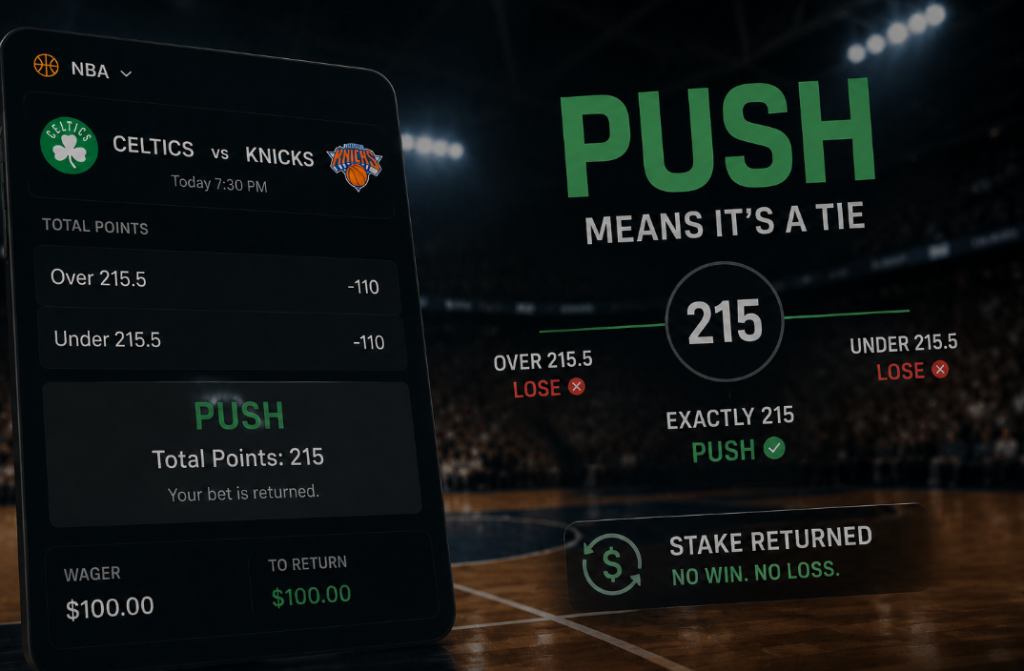
A push in betting happens when the final result lands exactly on the sportsbook’s line, so the wager is neither a win nor a loss and the original stake is normally returned. For example, if a Canadian bettor takes Over 6.0 goals in an NHL game and the teams combine for exactly six goals, the bet pushes.
That means there is usually no profit and no loss. If you staked C$25, you would normally receive the same C$25 back rather than the full winning payout.
Understanding what a push means in betting is especially useful when reading whole-number spreads and totals, because those markets can finish exactly on the listed line.
🔎 A Push in One Simple Example
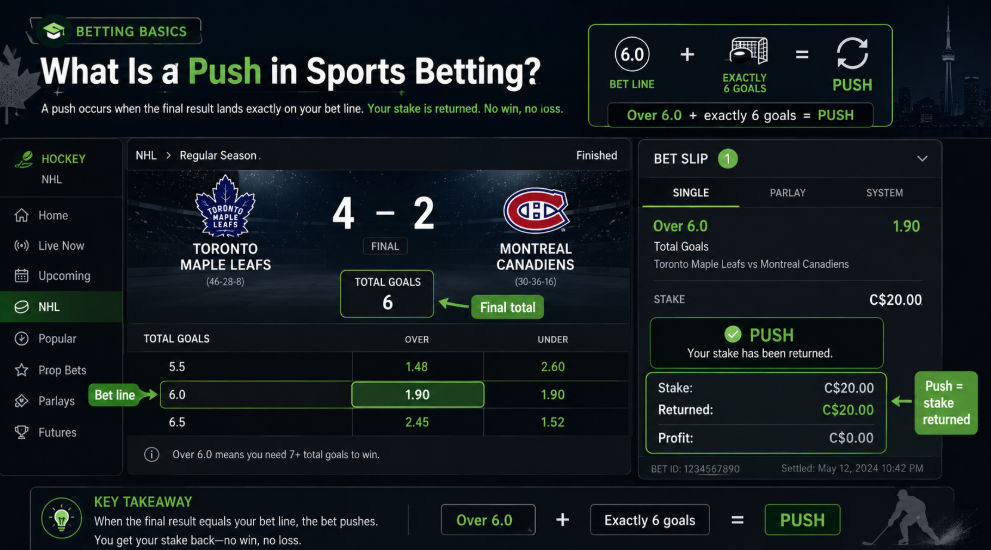
Consider a hypothetical NHL game between the Toronto Maple Leafs and Montreal Canadiens.
The sportsbook lists Over 6.0 Total Goals at 1.90, and a bettor stakes C$20. The game ends 4–2, meaning the two teams score exactly six goals.
Because the final total matches the line of 6.0, the wager does not win or lose. It settles as a push.
| Item | Amount |
|---|---|
| Original stake | C$20 |
| Amount returned | C$20 |
| Profit | C$0 |
| Loss | C$0 |
If the same C$20 bet at 1.90 had won, the total return would have been C$38. Because it pushed instead, the bettor normally receives only the original C$20 stake back.
The key point is simple: a push normally returns the stake; it does not trigger the winning payout.
🤔 Why Does a Bet Become a Push?
A bet becomes a push when the final result matches a push-eligible betting line exactly.
For example, Over 6.0 goals pushes if exactly six qualifying goals are scored. A team at −3 pushes if it wins by exactly three points. An Over 220 basketball total pushes if the teams combine for exactly 220 points.
The wager effectively ties the sportsbook’s line.
This is why a betting push is different from both a win and a loss.
🆚 Push vs. Win vs. Loss
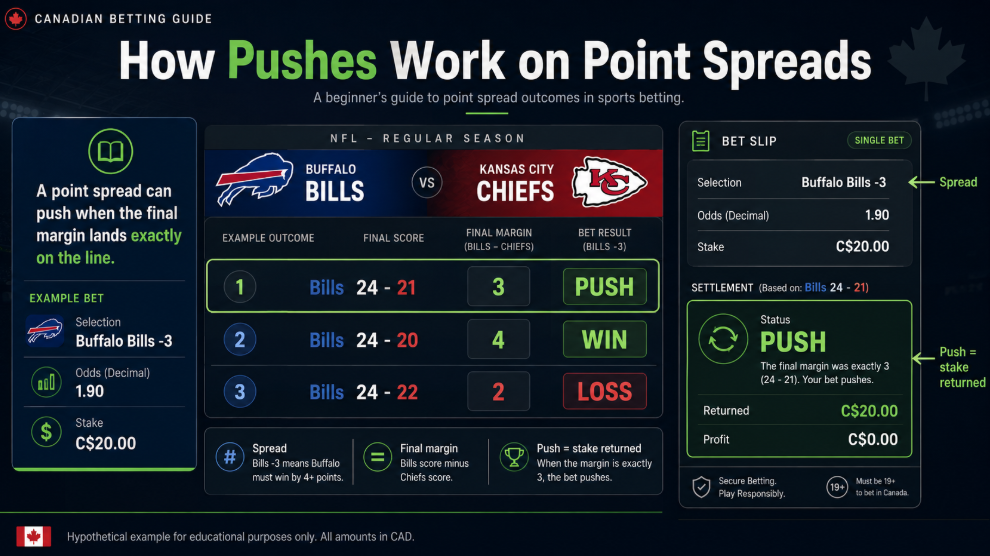
Suppose a bettor takes Buffalo Bills −3.
| Final Result | Settlement |
|---|---|
| Bills win by 4 or more | Win |
| Bills win by exactly 3 | Push |
| Bills win by 2 or fewer, or lose | Loss |
The same principle applies to totals. If you bet Over 6.0 goals, seven or more goals produce a win, exactly six produces a push, and five or fewer produces a loss.
A push therefore sits directly between a win and a loss: the selection did not beat the line, but it did not fall short of it either.
🤔 What Happens to Your Money on a Push?
On a standard pushed single wager, the original stake is normally returned.
Suppose you place C$50 at decimal odds of 1.90. If the bet wins, the total return is C$95, which includes the C$50 stake and C$45 profit. If it pushes, the C$50 stake is normally returned with C$0 profit. If it loses, the C$50 stake is lost.
This distinction matters because receiving your stake back is not the same as receiving a winning payout.
A push normally leaves you with no profit and no net loss on that wager.
👀 Why Can 6.0 Push but 6.5 Cannot?
A whole-number line can sometimes be matched exactly. A half-point line normally cannot.
For an NHL total of 6.0, a game that finishes with exactly six goals lands directly on the line, creating a push.
With 6.5, the game cannot finish with 6.5 goals. It must finish above or below that number. Seven or more goals would settle the Over as a win, while six or fewer would settle it as a loss.
The same idea applies to spreads. A team at −3 can push if it wins by exactly three points. A team at −3.5 normally cannot push because the scoring margin cannot be exactly three and a half points.
This is one reason half-point lines are common in sports betting.
📌 How Pushes Work on Point Spreads
Point spreads are one of the most common markets where beginners encounter pushes.
Imagine a bettor takes Buffalo Bills −3. If Buffalo wins 24–21, the winning margin is exactly three points. Because that equals the spread, the wager pushes.
If Buffalo wins 24–20, the margin is four and the −3 spread wins. If Buffalo wins 24–22, the margin is only two and the −3 spread loses.
The actual winner of the game is therefore not enough to determine whether a spread bet wins. The important question is how the final margin compares with the listed spread.
📌 How Pushes Work on Over/Under Bets
Totals can also push when the line uses a whole number.
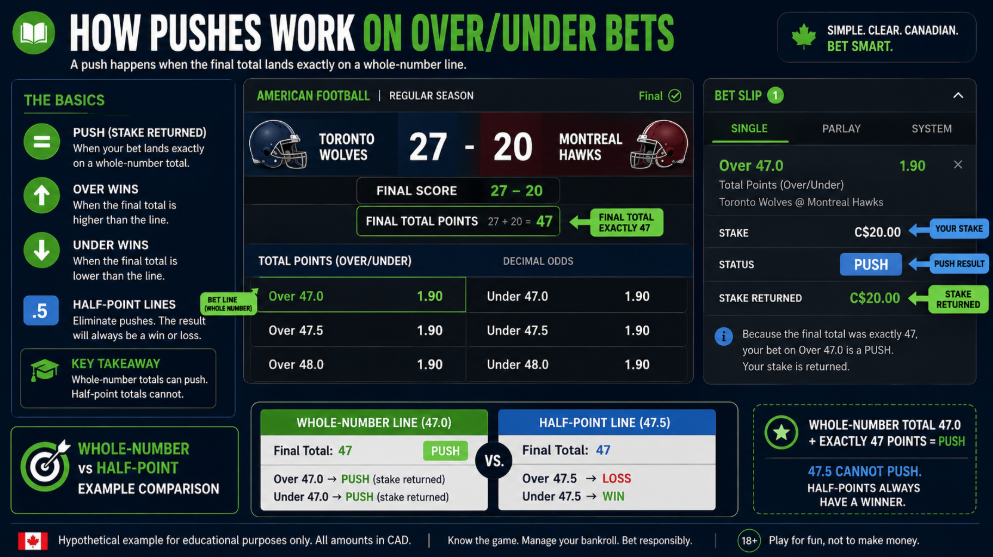
Suppose the market is Over 47.0 and the final football score is 27–20. The teams combine for exactly 47 points, so the wager lands on the line and pushes.
If the total had instead been 47.5, the same result would not create a push. Over 47.5 would lose, while Under 47.5 would win.
For a beginner, the simplest rule is that whole-number totals can sometimes push, while half-point totals normally force the wager to finish on one side of the line or the other.
🤔 Can a Moneyline Bet Push?
Pushes are most commonly associated with spreads and totals, but moneyline settlement depends on the exact structure of the market.
A standard moneyline usually asks which team or player wins. However, settlement can depend on whether a draw is available as a separate outcome, whether overtime is included, the sport involved, and the sportsbook’s published market rules.
For that reason, it is safer not to assume that every moneyline works identically.
Canadian bettors should check the exact market title and settlement rules before confirming a wager.
🤔 What Happens to a Push in a Parlay?
A push inside a parlay is usually handled differently from a push on a single bet.
In many standard parlays, the pushed leg is removed and the wager is recalculated using the remaining selections. For example, if a three-leg parlay contains two wins and one push, the bet may effectively settle as a two-leg parlay.
That does not mean every operator handles parlay pushes in exactly the same way. The payout and settlement can depend on the sportsbook’s rules and the type of wager.
The safest assumption is not to assume anything: check the parlay settlement rules shown by the operator.
👉 Pushes in Teaser Bets Can Work Differently
Teaser bets can have their own push rules, and those rules may be more specific than standard parlay rules.
A pushed teaser leg may reduce the number of legs, alter the payout, void the wager, or receive another operator-specific treatment depending on the sportsbook.
For this reason, a bettor should not assume that a push inside a teaser works the same way as a push inside an ordinary parlay.
🆚 Push vs. Void Bet: What Is the Difference?
A push and a void can both result in the original stake being returned, but they happen for different reasons.
A push happens because the event takes place and the final result matches the betting line exactly. For example, Over 6.0 goals pushes if the game finishes with exactly six qualifying goals.
A void usually happens because the wager cannot be settled normally under the relevant rules. This can happen because of a cancelled event, a participation condition, or another market-specific reason.
The financial result may sometimes look similar, but the settlement reason is different.
🤔 Push vs. Draw: Are They the Same?
No.
A draw is an actual sporting result or an available market outcome. A push describes how a wager settles relative to its betting line.
A football team can win a game by exactly three points while a −3 spread still pushes. The game was not a draw; the bet simply landed exactly on the spread.
That distinction is especially important for beginners because the word “tie” can refer either to the sports result or to the wager matching the line.
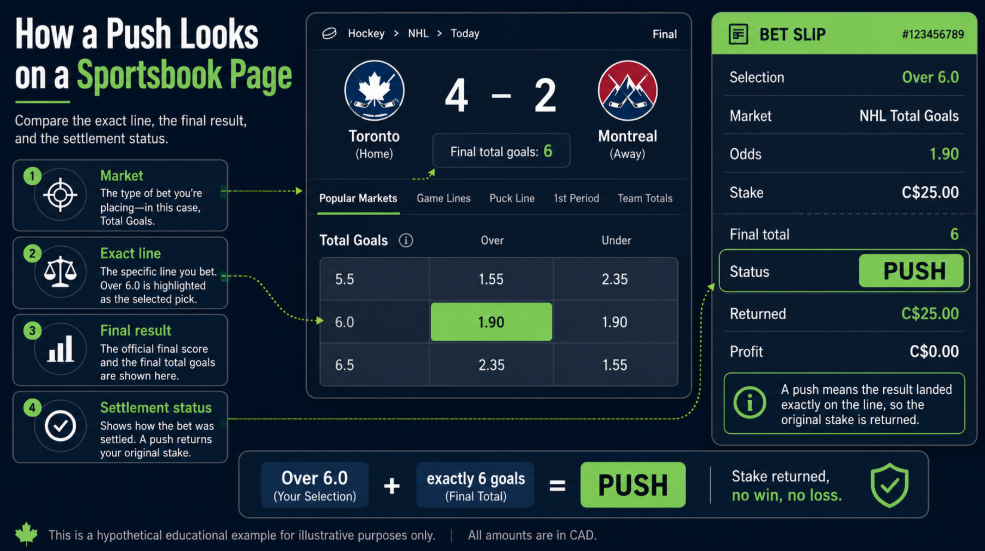
📌 How a Push Looks on a Sportsbook Page
A simplified ticket might show NHL Total Goals — Over 6.0 at 1.90, with a C$25 stake and a final game total of six goals.
After settlement, the bet history could show Push, with C$25 returned and C$0 profit.
The important information to compare is the market, the exact line, the final result, and the settlement status. Looking only at the final score is not enough; you need to compare that score with the line shown on the accepted ticket.
🤔 What If the Odds Were 2.50 — Do I Still Only Get My Stake Back?
Normally, yes.
Suppose you stake C$20 at 2.50. If the wager wins, the potential total return is C$50.
If the same bet pushes, the winning payout is not triggered. The original C$20 stake is normally returned instead.
So although the ticket may have shown a C$50 potential return before the event, a push would generally leave you with C$20 returned and C$0 profit.
🤔 Does a Push Affect Your Betting Balance?
A push normally restores the amount committed to the wager.
Imagine your balance is C$100 and you place a C$20 bet. While the bet is open, your available balance may effectively fall to C$80. If the wager pushes and the C$20 stake is returned, the balance would normally return to C$100, assuming there is no other account activity.
The exact interface varies by sportsbook, but the economic result is straightforward: no gain and no loss on the pushed stake.
🤔 Can a Live Bet End in a Push?
Yes, if the live market uses a line that can be matched exactly and the operator’s rules allow push settlement.
For example, a live NHL total of 5.0 can potentially push if the game finishes with exactly five qualifying goals.
As with pre-game bets, bettors should still check whether overtime, extra periods, or other conditions are included in the market.
✅ How to Check Whether Your Bet Was a Push
Check the exact market you selected.
Check the betting line shown on the accepted ticket.
Compare that line with the official final result.
Check the sportsbook’s settlement status and market rules.
If the result matches a whole-number line exactly and the market allows a push, the wager will normally be settled as neither a win nor a loss.
❓ FAQ
A push in betting occurs when the final result matches the sportsbook’s line exactly. The wager is normally neither a win nor a loss, so the original stake is returned. For example, Over 6.0 goals pushes if exactly six qualifying goals are scored.
On a standard pushed single wager, the original stake is normally returned. If you bet C$25 and the wager pushes, you would usually receive C$25 back with C$0 profit.
Neither. A push means the result tied the betting line, so the original stake is normally returned rather than paid as a win or lost.
Normally no. A push generally returns the original stake, which means the profit is C$0.
A push occurs when a push-eligible market finishes exactly on its listed line. A team at −3 winning by exactly three points is a common example.
A spread pushes when the final scoring margin matches the spread exactly. If you bet a team at −3 and it wins by exactly three, the wager normally pushes.
An Over/Under bet pushes when the final total equals a whole-number line exactly. Over 47.0, for example, can push if the game finishes with exactly 47 combined points.
In many standard parlays, the pushed leg is removed and the wager is recalculated using the remaining legs. Exact treatment depends on sportsbook rules.
A push happens because the result lands exactly on the betting line. A void happens because the wager cannot be settled normally under the applicable rules.
Normally no. A half-point line such as 6.5 or −3.5 prevents the result from landing exactly on the line in sports that score in whole units.



- Casino of games and sports betting
- Generous bonuses and promotions
- Security measures and fair play

- Hundreds of slots, table games
- Welcome bonus and reload bonuses
- Mobile app and mobile website

100% up to C$500
- Groovy bonuses and inducements
- Dedicated VIP program
- Multiple payment methods

100% up to $750 + 200 FS


- Over 4000 casino games
- 25+ sports, with live streaming
- Great range of payment options

100% up to 5 BTC

- Sportsbook with 35+ sports
- Ongoing and reload promotions
- Industry competitive odds


- Library of slots, table games
- Attractive welcome bonuses
- Program with exclusive benefits

Bonus 100% up to C$500
- Extensive game selection
- Welcome bonuses and promotions
- Comprehensive VIP program




Bonus 100% up to C$500
- Games from top-tier providers
- Welcome bonuses and promotions
- Dedicated apps for iOS and Android

Bonus 100% up to C$250
- A vast selection of games
- Attractive bonuses and promotions
- A variety of banking methods


What Is the Legal Betting Age in Canada?
The legal betting age in Canada is 18 or 19 depending on the province, territory and, in some cases, whether the bet is placed online or through a retail product. Alberta, Manitoba and Quebec generally allow regulated sports betting from age 18, while most other Canadian jurisdictions require bettors to be 19. Ontario is the […]

What Is Line Movement?
Line movement is a change in the odds, point spread or total offered by a sportsbook after a betting market has opened. For Canadian bettors, it shows how the market price changes as new information, betting activity or sportsbook adjustments affect the original line. For example, if the Toronto Maple Leafs open at 2.10 and […]

What Is +EV Betting?
+EV betting means placing a wager with a positive expected value, where the bettor believes the potential payout is high enough relative to the probability of winning to produce a theoretical long-term profit. For Canadian bettors, this means evaluating both the sportsbook price and an estimated probability rather than looking only at which team is […]

What Is Value Betting?
Value betting means placing a wager when the odds offered by a sportsbook are higher than the bettor believes the true probability of that outcome justifies. For Canadian bettors, this means comparing the sportsbook’s decimal odds with an estimated fair price rather than simply choosing the team or player most likely to win. For anyone […]