

Bankroll management is the practice of setting aside a specific amount of money for betting and limiting how much of that bankroll is risked on each wager. For Canadian bettors, a bankroll might be C$500, C$1,000 or another amount that has been specifically allocated to betting rather than everyday expenses or emergency savings.
For anyone asking what is bankroll management, the key idea is risk control. A betting bankroll gives the bettor a defined pool of funds, while a staking system determines how much of that pool is exposed to each individual bet.
Good bankroll management in betting does not make a wager more likely to win and does not guarantee profit. Its purpose is to reduce the impact of individual losses and make it less likely that one bad bet or short losing streak wipes out the entire amount set aside for betting.
🤔 What Counts as a Betting Bankroll?
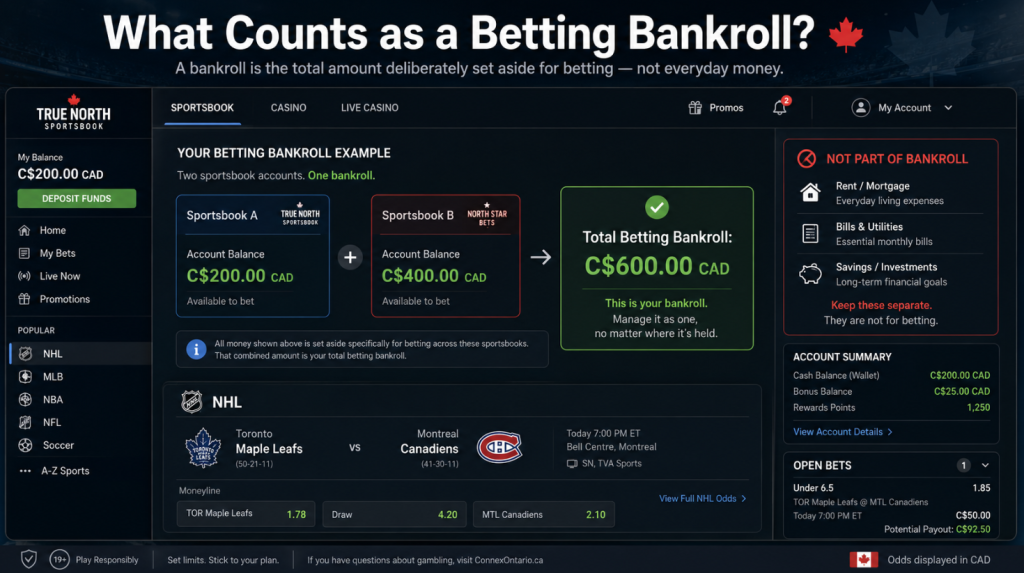
A betting bankroll is the total amount of money a bettor has deliberately allocated to wagering.
Suppose a Canadian bettor decides that C$600 is the maximum amount they want to use for sports betting. That C$600 becomes the bankroll.
The important distinction is that the bankroll should be separate from money needed for rent, bills, savings or other regular expenses. If the C$600 is lost, the bettor should not automatically treat personal savings as additional bankroll.
A bankroll is also different from the balance shown inside one sportsbook account.
For example, a bettor might have C$200 deposited at one sportsbook and C$400 at another. Their total sports betting bankroll is still C$600.
Likewise, a sportsbook balance can increase after a winning bet or decrease after a loss, but that does not change the underlying purpose of the bankroll: it is the pool of betting funds used to determine how much can reasonably be risked.
🤔 Why Bankroll Management Matters
The size of individual bets can dramatically affect how long a bankroll lasts.
Imagine two bettors who each start with C$500.
Bettor A places C$250 on a single NHL game. If the bet loses, half of the entire bankroll disappears immediately.
Bettor B stakes C$20 on the same game. If the wager loses, the bankroll falls from C$500 to C$480.
Both bettors picked the same losing outcome, but their financial exposure was very different.
This is one of the main reasons sports betting bankroll management matters. Even a wager that appears attractive can lose, and several losses can occur consecutively.
By keeping individual stakes relatively small compared with the overall bankroll, a bettor gives the remaining funds more room to absorb short-term losses.
Bankroll management therefore controls exposure to results. It does not control the results themselves.
🤔 What Is a Betting Unit?
A betting unit is a standard amount used to describe stake size.
Instead of saying that every bet is C$20, a bettor can define C$20 as one unit.
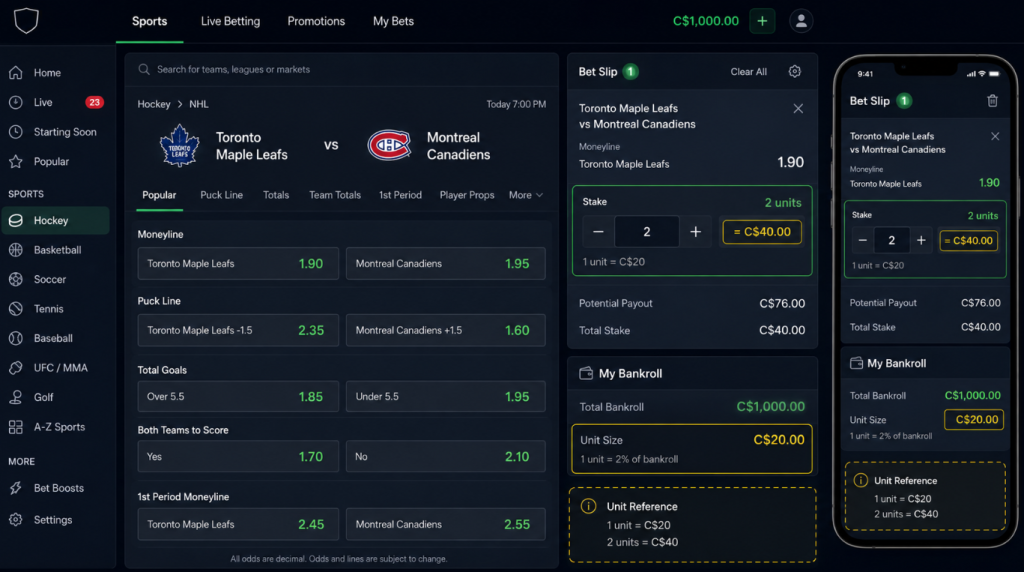
Suppose the bankroll is C$1,000 and one unit is C$20.
In this example:
1 unit = C$20 = 2% of the bankroll
If the bettor places a two-unit wager, the stake is C$40.
Units make it easier to express bet size relative to a bankroll. This is especially useful when bankrolls differ between bettors.
For example, a C$20 wager might be a small bet for someone with a C$5,000 bankroll but a very large bet for someone with only C$100 available.
There is no universal rule requiring one unit to equal a particular percentage. Different bankroll strategies use different unit sizes depending on the amount of risk the bettor is prepared to accept.
🤔 How Much of Your Bankroll Should You Bet?
There is no single percentage that is appropriate for every bettor.
Many bankroll approaches use relatively small stake sizes because smaller bets reduce the effect of any single loss.
For a C$1,000 bankroll, a 1% stake is C$10. A 2% stake is C$20, while a 5% stake is C$50.
The difference becomes much more noticeable during a losing run.
Ten C$10 losses would reduce the original bankroll by C$100 before any adjustments.
Ten C$50 losses would represent C$500 of stakes.
This does not mean that 1% is automatically correct and 5% is automatically wrong. It means that larger bankroll percentages create larger fluctuations in the value of the bankroll.
The appropriate stake size depends on the betting method, personal risk tolerance and how much volatility the bettor is willing to accept.
🔎 Bankroll Example for a Canadian Bettor
Consider a Canadian bettor starting with a bankroll of C$800.
They decide that one betting unit will equal 2% of the starting bankroll.
That produces a unit size of:
C$800 × 2% = C$16
The bettor places C$16 on one selection at decimal odds of 1.90.
A second regular wager is also C$16, even if the first bet loses.
Later, the bettor chooses a two-unit position under their predetermined system. That stake would be C$32.
The important point is that the bet sizes come from the staking rules rather than from the emotional result of the previous wager.
If the bankroll later falls substantially, perhaps to C$600, the bettor may decide at a scheduled review point to recalculate the unit size.
At 2%, a C$600 bankroll would produce a C$12 unit.
If the bankroll instead grows to C$1,000, a 2% unit would be C$20.
This is one way a percentage-based bankroll management strategy can keep individual bets proportional to the amount of betting money currently available.
🆚 Fixed Stakes vs Percentage-Based Stakes
There are several ways bettors can structure their staking without changing their approach after every result.
| Method | How It Works | Example with C$1,000 Bankroll |
|---|---|---|
| Fixed Stake | The same C$ amount is used for most bets | C$20 per wager |
| Percentage-Based | Stake is calculated as a percentage of the current bankroll | 2% = C$20 initially |
| Unit-Based | Bets are expressed in standard units | 1 unit = C$20 |
With fixed stakes, a bettor might continue placing C$20 wagers even if the bankroll moves from C$1,000 to C$900.
A percentage-based method changes the stake according to the bankroll. If a 2% system is used and the bankroll decreases, the stake also becomes smaller. If the bankroll grows, the stake may increase.
A unit-based system can overlap with either approach. A unit can remain fixed for a period or be recalculated periodically as a percentage of the bankroll.
None of these methods guarantees better betting results. They simply provide different ways of keeping bet sizing consistent.
🧐 What Happens to Your Bankroll During a Losing Streak?
Losing streaks are one of the clearest reasons to think about stake sizing before placing bets.
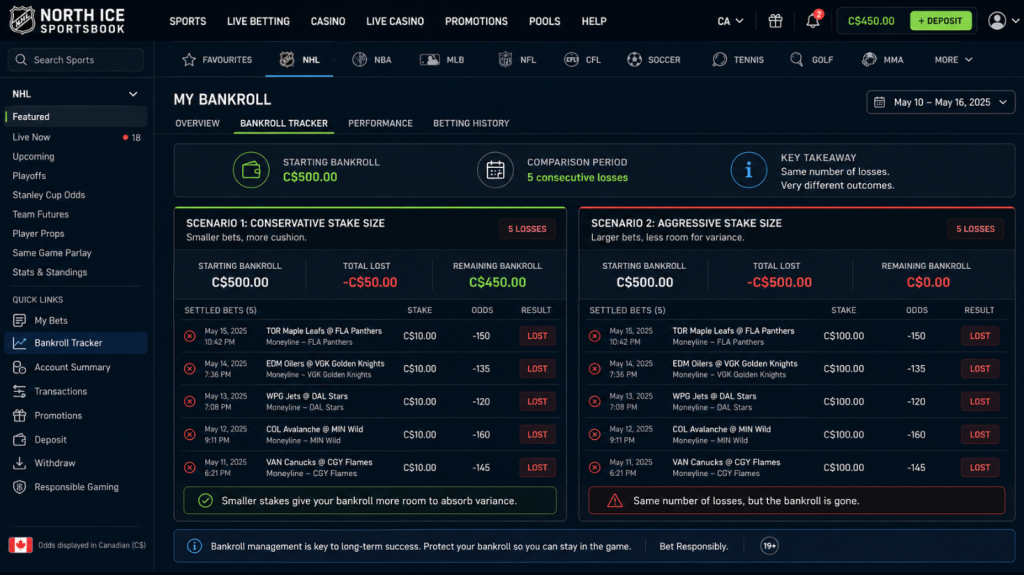
Suppose a bettor begins with C$500 and risks C$10 per wager.
Five consecutive losses would represent C$50 in losing stakes, leaving C$450 if there were no other bets.
Now imagine the same bettor risks C$100 on each wager.
Five consecutive C$100 losses could consume the entire C$500 bankroll.
The selections may have been identical, but the staking approach created completely different outcomes for the remaining betting funds.
Short-term betting results can fluctuate significantly. This fluctuation is often described as variance.
Variance means that a bettor can experience several wins or losses close together even when following the same selection process.
Smaller stakes give a bankroll more capacity to absorb that variation.
📌 How to Manage a Betting Bankroll
A simple bankroll system should focus on defining the funds, setting stake limits and tracking results consistently.
➤ How to Manage a Betting Bankroll
Set a separate amount of money that you can afford to use only for betting.
Choose a standard unit size or a small percentage of the bankroll for regular wagers.
Record every bet, including the stake, odds, result and updated bankroll.
Avoid increasing stake sizes simply because the previous bet lost.
Review the bankroll periodically and adjust unit size only according to the system you selected.
Stop adding money automatically when losses reach the original bankroll limit.
The most important part of how to manage a betting bankroll is consistency.
If a bettor decides that one regular wager is C$20, changing the next stake to C$100 simply because the previous bet lost defeats much of the purpose of having a staking system.
Bankroll rules are most useful when they are established before the emotional outcome of a wager is known.
🤔 Why Chasing Losses Can Damage a Bankroll
Chasing losses occurs when a bettor increases stakes mainly to try to recover money lost on previous bets.
For example, a bettor loses C$20 and responds by betting C$40 on the next wager.
That bet also loses, so the next stake rises to C$80.
The total loss is now:
C$20 + C$40 + C$80 = C$140
The size of the bets increased rapidly even though there was no guarantee that any of the following wagers would win.
This type of aggressive progression can deplete a bankroll much faster than a consistent staking method.
Some betting systems involve doubling stakes after losses, but the fundamental problem remains the same: losing sequences can continue longer than expected, while bankrolls and sportsbook betting limits are finite.
A previous loss does not make the next bet more likely to win.
For this reason, the size of a new wager should not be determined solely by how much money the bettor wants to recover.
🤔 Should Bet Size Change Based on Confidence?
Some bettors vary their stakes depending on how strongly they rate a particular wager.
For example, they may use one unit for a standard selection and two units for a bet they believe has greater value.
The problem for beginners is that subjective confidence can be misleading.
Feeling certain that the Toronto Maple Leafs will win does not make the result certain. Injuries, penalties, unexpected performances and random game events can still change the outcome.
A bettor who normally risks C$20 but suddenly stakes C$250 because a selection “cannot lose” has abandoned the original risk structure.
If stake sizes are allowed to vary, the maximum sizes should still be defined as part of the bankroll strategy in advance.
Confidence should not become an excuse to expose a large portion of the bankroll to one uncertain event.
📊 Bankroll Management and Betting Odds
Bankroll management determines how much is risked. Betting odds determine the potential return and imply information about the probability and pricing of the outcome.
These are related concepts, but they are not the same.
Suppose a bettor uses a C$20 regular stake.
At decimal odds of 1.50, the potential total payout is:
C$20 × 1.50 = C$30
At 2.00:
C$20 × 2.00 = C$40
At 3.00:
C$20 × 3.00 = C$60
Higher odds create a larger potential payout from the same stake, but they do not automatically justify increasing the stake.
A bet at 3.00 is not made safer by staking more money on it.
The purpose of bet sizing is to control financial exposure, while the odds describe the price offered on the selection.
Keeping those two decisions separate can help bettors avoid increasing risk simply because a potential payout looks attractive.
🧐 Should You Recalculate Your Unit Size?
Unit size does not necessarily need to change after every bet.
Some bettors keep their unit fixed for a week, month or another predetermined period. Others recalculate after the bankroll changes by a meaningful amount.
Suppose a Canadian bettor begins with C$1,000 and defines one unit as 2%.
The initial unit is C$20.
If the bankroll later falls to C$750 and the bettor decides it is time for a scheduled adjustment, 2% becomes C$15.
If the bankroll increases to C$1,250, the same percentage would produce a C$25 unit.
Periodic recalculation can keep the stake proportional to the bankroll without allowing every single result to trigger an immediate change in betting behaviour.
The important point is that the method should be predetermined rather than improvised after wins or losses.
🆚 Bankroll vs Betting Budget
A betting bankroll and a betting budget are related but can describe different things.
A betting budget generally refers to the personal spending limit a bettor has decided is acceptable over a certain period.
The bankroll is the pool of funds already allocated to betting and used to determine stake sizes.
For example, someone may have a total betting bankroll of C$1,000 but decide that no more than C$200 of additional personal money can be deposited during a particular month.
The monthly budget and total bankroll are therefore not necessarily identical.
This distinction matters because bankroll management should not become a justification for continually transferring more money into betting accounts.
Budgeting controls how much personal money is allocated to betting. Bankroll management controls how the already allocated funds are exposed to individual wagers.
❌ Common Bankroll Management Mistakes
➤ Betting Too Much on One Game
A large wager concentrates a significant portion of the bankroll in a single uncertain outcome.
If someone has C$500 and risks C$250 on one game, a single loss removes 50% of the available betting funds.
The bettor would then need a 100% gain on the remaining C$250 simply to return to the original C$500 bankroll.
➤ Increasing Stakes After Losses
Increasing a bet simply because the previous wager lost is a form of chasing.
The previous outcome does not improve the probability of the next selection, so increasing the stake mainly increases financial exposure.
➤ Treating Sportsbook Balance as Extra Money
A growing sportsbook balance can make winnings feel separate from the bettor’s own money.
From a bankroll perspective, however, those funds are still part of the total amount available for betting.
If a C$500 bankroll grows to C$700, the additional C$200 should not automatically be treated as money that can be risked without limits.
➤ Depositing Again Every Time the Bankroll Reaches Zero
If the original bankroll was defined as the maximum amount available for betting, repeatedly replacing it after losses removes that limit.
A bankroll only functions as a risk boundary when reaching the limit has consequences.
➤ Changing the System After Every Result
One win does not prove that a staking method works, and one loss does not prove that it fails.
Constantly changing unit sizes based on recent outcomes can make it difficult to track risk consistently or understand how the original system actually performed.
🍁 Bankroll Management for Canadian Bettors
For Canadian bettors, bankroll management can involve funds spread across several sportsbook accounts.
Suppose a bettor keeps C$300 at Sportsbook A, C$200 at Sportsbook B and C$500 at Sportsbook C.
The overall betting bankroll is:
C$300 + C$200 + C$500 = C$1,000
It is not necessarily three separate bankrolls just because the funds sit in different accounts.
Tracking the combined total can provide a clearer picture of overall betting exposure.
Canadian bettors may also have access to responsible gambling tools such as deposit limits, loss limits or time-based controls, depending on the sportsbook and the rules that apply in their province or territory.
These platform tools are separate from a personal bankroll system, but they can support the same broader goal of defining limits before betting activity occurs.
Using C$ amounts and decimal odds also makes it relatively straightforward to compare stake sizes and payouts across different accounts.
🤔 Does Bankroll Management Make Betting Profitable?
No.
Bankroll management does not create a profitable betting strategy by itself.
A bettor could follow perfect staking discipline and still lose money if the selections consistently perform poorly or if the prices taken do not provide enough value.
Likewise, managing a bankroll does not change the probability that the next bet will win.
What it can change is how quickly money is exposed to risk.
A bettor risking C$10 from a C$1,000 bankroll can survive far more losing wagers than someone risking C$500 at a time.
That makes sports betting bankroll management a risk-control method rather than a prediction system.
It can help structure losses and limit exposure, but it cannot guarantee profit or eliminate the possibility of losing the entire betting bankroll.
❓ FAQ
Bankroll management means defining a specific pool of betting funds and controlling how much of that pool is risked on each wager. Its purpose is to manage financial exposure rather than predict which bets will win.
There is no universal bankroll amount.
A bankroll should be based on a bettor’s personal finances and consist only of money specifically allocated to betting and affordable to lose.
For one bettor that might be C$200, while another may choose C$1,000. The amount itself is less important than maintaining the boundary between betting money and funds needed for everyday life.
There is no single percentage that works for every bettor.
Many conservative bankroll management strategies use relatively small percentages so individual losses have a limited impact, but the appropriate amount depends on risk tolerance and the staking method being used.
One unit is a standard bet size used to express stakes consistently.
For example, if a bettor has a C$1,000 bankroll and defines one unit as C$20, a two-unit wager would be C$40.
Increasing a stake solely to recover the previous loss can rapidly increase risk.
A losing bet does not make the next selection more likely to win, so stake sizes should generally follow the bettor’s predetermined bankroll system rather than recent results.
Yes.
A bettor can keep money in several sportsbook accounts while treating all of those funds as part of one overall bankroll.
For example, C$400 at one sportsbook and C$600 at another can represent a C$1,000 total bankroll.
No.
Bankroll management limits and structures risk, but it cannot eliminate betting losses or guarantee that a bettor will remain profitable.



- Casino of games and sports betting
- Generous bonuses and promotions
- Security measures and fair play

- Hundreds of slots, table games
- Welcome bonus and reload bonuses
- Mobile app and mobile website

100% up to C$500
- Groovy bonuses and inducements
- Dedicated VIP program
- Multiple payment methods

100% up to $750 + 200 FS


- Over 4000 casino games
- 25+ sports, with live streaming
- Great range of payment options

100% up to 5 BTC

- Sportsbook with 35+ sports
- Ongoing and reload promotions
- Industry competitive odds


- Library of slots, table games
- Attractive welcome bonuses
- Program with exclusive benefits

Bonus 100% up to C$500
- Extensive game selection
- Welcome bonuses and promotions
- Comprehensive VIP program




Bonus 100% up to C$500
- Games from top-tier providers
- Welcome bonuses and promotions
- Dedicated apps for iOS and Android

Bonus 100% up to C$250
- A vast selection of games
- Attractive bonuses and promotions
- A variety of banking methods


What Is the Legal Betting Age in Canada?
The legal betting age in Canada is 18 or 19 depending on the province, territory and, in some cases, whether the bet is placed online or through a retail product. Alberta, Manitoba and Quebec generally allow regulated sports betting from age 18, while most other Canadian jurisdictions require bettors to be 19. Ontario is the […]

What Is Line Movement?
Line movement is a change in the odds, point spread or total offered by a sportsbook after a betting market has opened. For Canadian bettors, it shows how the market price changes as new information, betting activity or sportsbook adjustments affect the original line. For example, if the Toronto Maple Leafs open at 2.10 and […]

What Is +EV Betting?
+EV betting means placing a wager with a positive expected value, where the bettor believes the potential payout is high enough relative to the probability of winning to produce a theoretical long-term profit. For Canadian bettors, this means evaluating both the sportsbook price and an estimated probability rather than looking only at which team is […]

What Is Value Betting?
Value betting means placing a wager when the odds offered by a sportsbook are higher than the bettor believes the true probability of that outcome justifies. For Canadian bettors, this means comparing the sportsbook’s decimal odds with an estimated fair price rather than simply choosing the team or player most likely to win. For anyone […]