

Sports betting is the practice of wagering money on the outcome of a sporting event, and Canadian bettors can place bets on NHL, NBA, football, tennis, and other sports through sportsbooks legally available in their province or territory. What sports betting is in practical terms is simple: a bettor chooses an outcome, the sportsbook assigns odds, the bettor enters a stake, and a winning bet is paid at the accepted odds. For example, a C$20 wager on the Toronto Maple Leafs at decimal odds of 2.00 returns C$40 if it wins, including the original C$20 stake. This guide shows how sports betting works in Canada. Availability and rules vary across Canada.
✍ How Does Sports Betting Work?
Sports betting works by choosing an outcome, entering a stake, and accepting the sportsbook’s odds. The process is the same whether you are betting on hockey, basketball, football, or another eligible sport.
A sportsbook publishes markets for an event
Each possible outcome receives odds.
You choose a market and selection.
You enter a stake, which is the amount wagered
The sportsbook accepts the bet and issues a bet slip
After the event, the bet is settled as a win, loss, push, or another result set out in the market rules.
A winning bet is paid according to its accepted odds.
The stake is the amount risked. The total return or payout includes the stake plus any profit. For instance, C$25 at decimal odds of 1.80 gives a C$45 total return if it wins: C$25 is the stake and C$20 is the profit.
💯 What Are Sports Betting Odds?
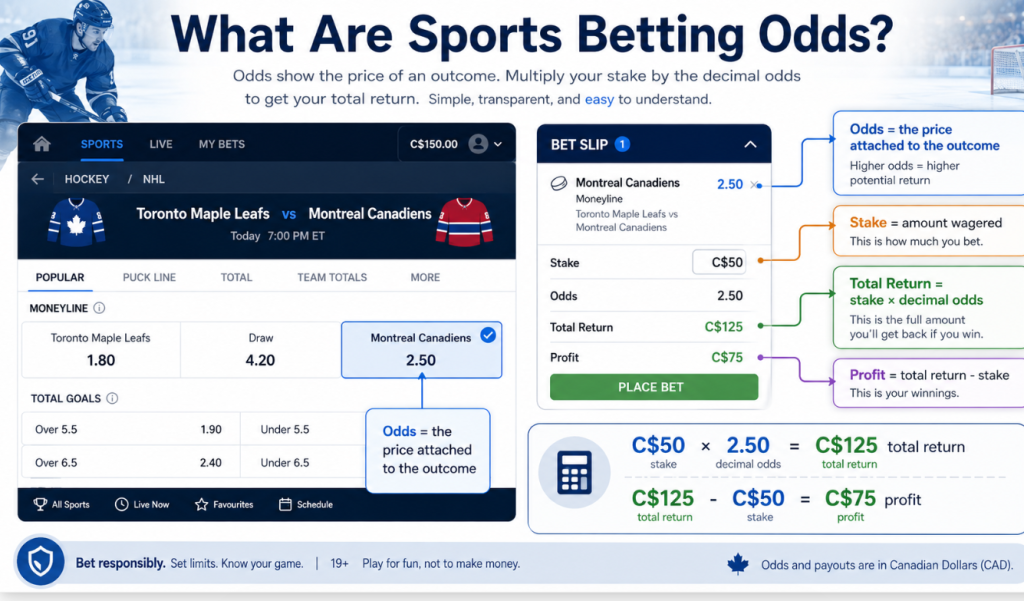
Sports betting odds show the price attached to an outcome and help calculate the potential return. They also reflect the sportsbook’s assessment of that outcome, rather than a promise that it will happen.
Decimal odds are common on Canadian betting sites. Multiply your stake by the decimal odds to calculate the total return:
C$50 × 2.50 = C$125 total return
C$125 − C$50 = C$75 profit
In this example, 2.50 is the odds, C$50 is the stake, C$125 is the return, and C$75 is the profit. You may also see American or moneyline odds, shown with a plus or minus sign, but the bet slip should always display the applicable price and potential payout.
💡 Most Common Types of Sports Bets
➜ Moneyline Bets
A moneyline bet is a wager on which team or athlete wins the event under the market rules. For example, Toronto Maple Leafs to win @ 1.80 wins if Toronto is the winning side as defined by that market. A moneyline is often one of the easiest types of bet for beginners to understand because it asks a direct question: who wins?
➜ Point Spread Betting
A point spread applies a handicap to a team before settlement. If the Toronto Raptors are listed at −4.5, they need to win by five or more points for that selection to win. The .5 removes an exact tie against the spread.
➜ Totals (Over/Under)
A total, also called Over/Under, asks whether a stated statistic finishes above or below the sportsbook’s line. For Over 5.5 total goals in an NHL game, the two teams must combine for six or more goals. The final winner does not determine a standard game total.
➜ Parlays
A parlay combines multiple selections into one bet. It can show a higher potential payout because every included selection usually has to win. If one selection loses, the parlay will normally lose, subject to the sportsbook’s market rules for pushes or voids.
➜ Proposition (Prop) Bets
A prop bet concerns a specific event or statistic rather than only the final winner. Examples include a player to score, a player’s points, or the number of goals in a period. Player, team, and game props can have different participation and settlement conditions, so read the market title carefully.
➜ Futures
A futures bet is settled later, often after a season or tournament. Examples include the Stanley Cup winner, NBA champion, or league MVP. The longer timeframe means the wager remains open until the relevant competition is decided or the market rules provide otherwise.
➜ Live Betting
Live betting, also called in-play betting, is betting after an event has started. The score, time remaining, and game state can affect the available markets and odds, which can change while the event continues.
📌 How to Place a Sports Bet in Canada
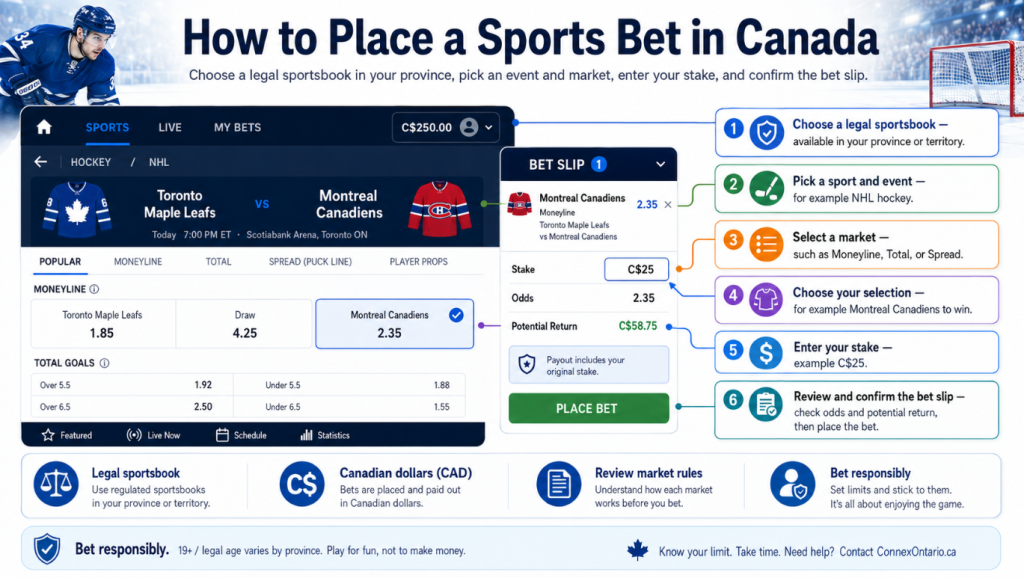
To bet on sports in Canada, use a sportsbook legally available in your province or territory, then choose an event, market, and selection before confirming the bet slip. For anyone learning how to bet on sports, the account and payment flow is straightforward but varies by operator.
Choose a sportsbook available where you live.
Create and verify an account if required
Deposit funds using an available payment method
Choose a sport and event
Select a betting market, such as a moneyline or total
Check the odds and exact market rules
Enter your C$ stake
Review the bet slip, including the potential return
Place the bet only if all details are correct
Follow the event and wait for settlement
Do not treat the potential return as guaranteed. The market, odds, stake, and settlement rules on the accepted ticket determine what you have actually placed.
➡️ Example of a Sports Bet
Consider the hypothetical NHL matchup Toronto Maple Leafs vs. Montreal Canadiens. The sportsbook lists Toronto Maple Leafs to win @ 1.80. A bettor enters a C$25 stake.
C$25 × 1.80 = C$45 total return
| Item | Amount | ||
|---|---|---|---|
| Stake | C$25 | ||
| Potential profit | C$20 | ||
| Potential total return | C$45 |
The important distinction is that return is not the same as profit. The C$45 return includes the original C$25 stake. This is a hypothetical example, not a current line or recommendation.
🛡️ Is Sports Betting Legal in Canada?
Sports betting is permitted in Canada within applicable federal and provincial or territorial frameworks, but the legal offering and availability of sportsbooks vary by location. Canada’s 2021 Criminal Code changes enabled provinces and territories to conduct and manage single-event sports betting; the changes came into force on August 27, 2021.
Ontario operates a regulated competitive iGaming market. The Alcohol and Gaming Commission of Ontario states that its internet gaming standards took effect when Ontario’s new market launched on April 4, 2022, and that registered operators can offer services to Ontarians under the applicable framework. Other provinces and territories can use different models. Check the rules and legal offerings that apply where you are located.
⚽ What Sports Can Canadians Bet On?
Canadians may see markets for hockey and the NHL, football including the NFL and CFL, NBA basketball, MLB baseball, soccer, tennis, golf, and MMA or UFC. The exact sports, competitions, and betting markets depend on the sportsbook, the province or territory, and the operator’s rules.
Hockey is a natural Canadian example, but the same mechanics apply elsewhere: select a market, read the odds, enter a stake, and check the ticket before you confirm.
📚 Sports Betting Terms Beginners Should Know
A sportsbook is a company or platform that accepts sports bets.
A bettor is a person placing a wager.
A stake is the amount of money wagered.
Odds are the price assigned to a betting outcome.
A payout or return is the total amount returned after a winning bet, including the original stake.
Profit is the amount won excluding the original stake.
A betting market is a specific event or outcome available to bet on.
A moneyline bet is a wager on which side wins.
A spread is a bet involving a points or goals handicap.
A total bet is a wager on whether a statistic finishes above or below a set number.
A parlay combines multiple selections into one bet.
A bet slip is the area where selections and the stake are entered before a bet is confirmed.
Learning these terms makes sports betting explained in a more practical way: you can read what a ticket is asking you to confirm rather than focusing only on the potential payout.
💲 Can You Make Money From Sports Betting?
Individual sports bets can win, but sports wagering is not a reliable source of income. Sportsbooks build a margin into their odds, outcomes are uncertain, and no result is guaranteed.
Knowledge of a sport may help you understand a market, but it does not remove financial risk. Decide the amount you are prepared to lose before you bet and avoid treating past losses as a reason to place another wager.
🆚 Sports Betting vs. Gambling: Is There a Difference?
Sports betting is a form of gambling because money is risked on an uncertain outcome. Its distinguishing feature is that the wager is linked to a real sporting event, such as a hockey game, tennis match, or football game.
Following a sport can help a bettor interpret teams, injuries, schedules, or market terms, but betting on sports cannot eliminate chance or guarantee a winning result.
🛡️ Responsible Sports Betting in Canada
Responsible betting means keeping the financial risk within limits you can afford. Set a C$ deposit or betting limit, take breaks when needed, and do not chase losses. Use the responsible gambling tools offered by a regulated platform.
iGaming Ontario describes responsible gambling as participation with less risk of harm and encourages informed choices, such as setting time or money limits and deciding to take a break. If betting stops being enjoyable, pause and seek support.
❓ FAQ
Sports betting is wagering money on a result connected to a sporting event. You choose an outcome, such as a team to win or a total to go Over or Under, enter a stake, and receive a return if the selection wins under the sportsbook’s rules.
A Canadian bettor uses a sportsbook available in their province or territory, selects an event and market, reviews the odds, enters a C$ stake, and confirms the ticket. If the bet wins, the sportsbook settles it using the accepted odds and applicable market rules.
Sports betting is permitted under applicable Canadian and provincial or territorial frameworks, but access and operators vary by location. Federal changes enabling provinces and territories to conduct and manage single-event sports betting took effect in 2021. Check the rules in your province or territory.
A moneyline is often one of the simplest bet types to understand because it asks which team or athlete wins. Simplicity does not mean a better chance of making money; the odds and the uncertainty of the event still apply.
In American odds, a plus sign usually shows the potential profit on a C$100-equivalent stake, while a minus sign shows the stake needed to make a C$100-equivalent profit. Minus and plus signs can also appear in spread markets, where they indicate a handicap. Check the displayed format before betting.
When a bet wins, the sportsbook settles the market and credits the total return according to the accepted odds and rules. The return includes your original stake. For example, a C$20 winning bet at 2.00 returns C$40 in total, including C$20 profit.
Tax treatment can depend on the facts, so this is general information rather than personal tax advice. CRA states that lottery winnings generally do not need to be reported unless they are income from employment, a business, property, or an achievement prize. Recreational gambling and business income can be treated differently; check current CRA guidance or obtain qualified tax advice for your situation.



- Casino of games and sports betting
- Generous bonuses and promotions
- Security measures and fair play

- Hundreds of slots, table games
- Welcome bonus and reload bonuses
- Mobile app and mobile website

100% up to C$500
- Groovy bonuses and inducements
- Dedicated VIP program
- Multiple payment methods

100% up to $750 + 200 FS


- Over 4000 casino games
- 25+ sports, with live streaming
- Great range of payment options

100% up to 5 BTC

- Sportsbook with 35+ sports
- Ongoing and reload promotions
- Industry competitive odds


- Library of slots, table games
- Attractive welcome bonuses
- Program with exclusive benefits

Bonus 100% up to C$500
- Extensive game selection
- Welcome bonuses and promotions
- Comprehensive VIP program




Bonus 100% up to C$500
- Games from top-tier providers
- Welcome bonuses and promotions
- Dedicated apps for iOS and Android
Bonus 100% up to C$250
- A vast selection of games
- Attractive bonuses and promotions
- A variety of banking methods


What Is the Legal Betting Age in Canada?
The legal betting age in Canada is 18 or 19 depending on the province, territory and, in some cases, whether the bet is placed online or through a retail product. Alberta, Manitoba and Quebec generally allow regulated sports betting from age 18, while most other Canadian jurisdictions require bettors to be 19. Ontario is the […]

What Is Line Movement?
Line movement is a change in the odds, point spread or total offered by a sportsbook after a betting market has opened. For Canadian bettors, it shows how the market price changes as new information, betting activity or sportsbook adjustments affect the original line. For example, if the Toronto Maple Leafs open at 2.10 and […]

What Is +EV Betting?
+EV betting means placing a wager with a positive expected value, where the bettor believes the potential payout is high enough relative to the probability of winning to produce a theoretical long-term profit. For Canadian bettors, this means evaluating both the sportsbook price and an estimated probability rather than looking only at which team is […]

What Is Value Betting?
Value betting means placing a wager when the odds offered by a sportsbook are higher than the bettor believes the true probability of that outcome justifies. For Canadian bettors, this means comparing the sportsbook’s decimal odds with an estimated fair price rather than simply choosing the team or player most likely to win. For anyone […]