
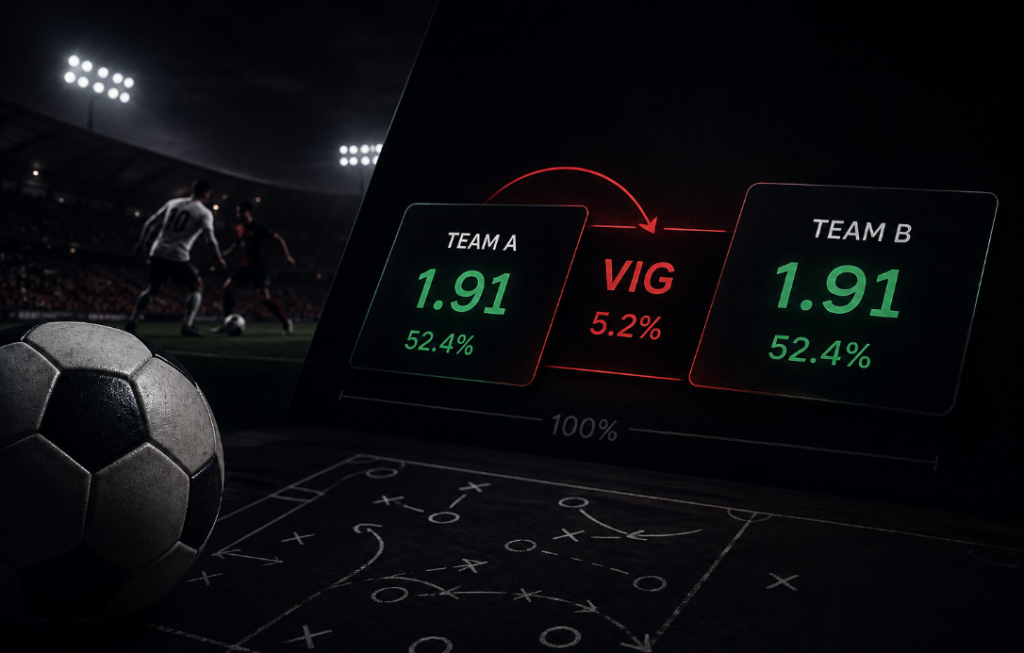
Vig is the margin a sportsbook builds into its betting odds, meaning Canadian bettors generally receive slightly less favourable prices than the true probabilities of the outcomes would suggest. Also called vigorish, sportsbook margin or sometimes juice, vig is one of the main ways a bookmaker creates a mathematical edge when pricing a betting market.
For anyone asking what is vig, the most important thing to understand is that it is usually not charged as a separate fee after you place or win a bet. Instead, the cost is already reflected in the odds offered by the sportsbook.
That is why understanding vig in sports betting can help bettors compare prices and see why apparently small differences in decimal odds can matter over time.
🔎 Where Is the Vig in Betting Odds?
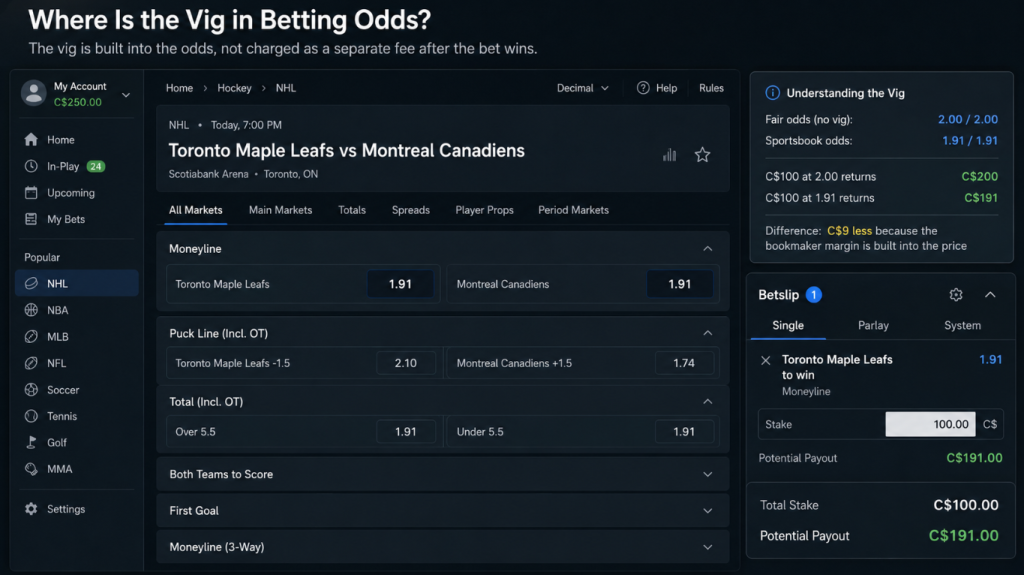
The easiest way to understand vig is to compare sportsbook odds with hypothetical fair odds.
Imagine an event with only two possible outcomes, and each outcome has a true 50% probability of happening.
Without any bookmaker margin, the fair decimal odds would be:
2.00 / 2.00
At 2.00 odds, a successful C$100 bet would return C$200, including C$100 in profit.
A sportsbook, however, might price the same two outcomes at:
1.91 / 1.91
Now a winning C$100 wager returns C$191 rather than C$200. The bettor still receives the original C$100 stake back as part of the payout, but the profit is C$91 instead of C$100.
That difference is an example of how sports betting vig is built into the price.
The sportsbook does not normally take another separate vig fee from the C$191 after the bet wins. The less favourable odds already account for the bookmaker’s pricing margin.
🎯 A Simple Vig Example for Canadian Bettors
Consider an NHL market involving the Toronto Maple Leafs and Montreal Canadiens.
Suppose a sportsbook offers decimal odds of 1.91 on Toronto and 1.91 on Montreal in a simplified two-outcome market.
Odds can be converted into implied probability using the formula:
Implied probability = 1 ÷ decimal odds
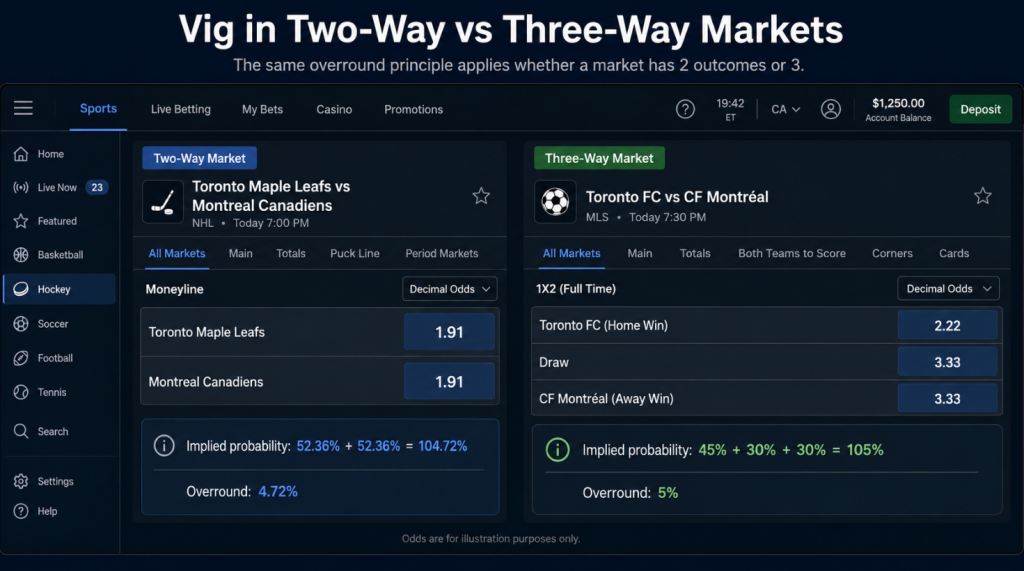
For odds of 1.91, the implied probability is approximately 52.36%.
That means the two sides together represent:
52.36% + 52.36% = 104.72%
But the probabilities of all possible outcomes in a theoretically fair market should add up to 100%.
The extra 4.72 percentage points are known as the overround, which gives bettors a useful indication of the margin built into the market.
This does not mean that the sportsbook will automatically make exactly 4.72% from every wager. Actual sportsbook results depend on how much money bettors place on each outcome and what ultimately happens.
The calculation instead shows how the odds have been priced above a total implied probability of 100%.
🤔 Why Do Sportsbooks Charge Vig?
Sportsbooks operate by offering prices on uncertain outcomes while maintaining a commercial margin.
Rather than usually charging Canadian bettors a visible transaction fee every time they place a sports wager, bookmakers can incorporate that margin directly into their odds.
This means a sportsbook can offer prices that are slightly less favourable than mathematically fair odds.
For example, if fair odds would theoretically be 2.00, the bookmaker might offer 1.91. That difference helps create an expected advantage for the operator across a large volume of betting activity.
A sportsbook also has operational costs and commercial risks, but for a bettor the key concept is simpler: the bookmaker vig is already reflected in the price being offered.
📌 How to Calculate Vig
For decimal odds, bettors can get a simple estimate of a market’s overround by converting each outcome into an implied probability.
How to Calculate Vig from Decimal Odds
Convert each betting odd into an implied probability by dividing 1 by the decimal odds.
Add the implied probabilities of all possible outcomes.
Compare the total with 100%.
The amount above 100% represents the market's overround.
Use the overround as a simple indication of the sportsbook margin built into the market.
For example, consider odds of 1.91 and 1.91.
1 ÷ 1.91 = approximately 52.36%
Both outcomes therefore produce:
52.36% + 52.36% = 104.72%
The overround is:
104.72% − 100% = 4.72%
This is a useful way to understand how to calculate vig, although overround and the sportsbook’s actual hold should not be treated as exactly the same measurement.
🆚 Vig vs Juice vs Hold vs Overround
Several related terms appear in sports betting content, but they do not all mean exactly the same thing.
| Term | Basic Meaning | How Bettors Usually See It |
|---|---|---|
| Vig / Vigorish | Margin built into sportsbook prices | Less favourable odds than fair odds |
| Juice | Informal term often used similarly to vig | Common in betting conversations |
| Overround | Total implied probability above 100% | Can be calculated from market odds |
| Hold | Percentage of betting handle the sportsbook actually retains | Usually measured from real betting results |
In everyday betting discussions, vig, vigorish and juice are often used in similar ways.
Overround is more specifically something bettors can estimate directly from a complete set of market odds.
Hold is different because it refers to what the sportsbook actually retains from betting activity over a period. It depends on real wagers and results, rather than only the prices posted before bets are settled.
🤔 Does Higher Vig Make a Bet Worse?
All else being equal, higher vig means less favourable pricing for the bettor.
Suppose two sportsbooks offer the same betting market.
One offers odds of 1.91, while another offers 1.95 on the exact same outcome under the same conditions.
A C$100 winning wager at 1.91 returns:
C$191
The same wager at 1.95 returns:
C$195
The difference is only C$4 on one C$100 bet, but repeated differences in pricing can accumulate across many wagers.
This is why experienced bettors often pay close attention to the actual odds rather than focusing only on which team or outcome they want to back.
However, a better price on one specific bet does not necessarily mean that one sportsbook is better in every respect. It simply means that the bettor is receiving a better price for that particular wager.
🔎 How Vig Affects Long-Term Betting Results
The impact of betting vig becomes easier to see when considering the break-even win rate.
At decimal odds of 2.00, a bettor would theoretically need to win 50% of identical wagers to break even before considering other variables.
At odds of 1.91, the implied probability is approximately 52.36%.
That means a bettor wagering repeatedly at 1.91 would need to win approximately 52.36% of those bets just to reach the theoretical break-even point.
The difference between 50% and 52.36% may appear small, but over dozens or hundreds of bets it becomes much more important.
This is why sportsbook margin matters even when it is not visible as a separate charge.
Vig effectively raises the performance level a bettor needs to overcome in order to be profitable over the long term.
⚽️ Is Vig the Same for Every Sport and Bet?
No. The amount of vig can vary substantially between betting markets.
A heavily traded NHL moneyline on a major game may be priced differently from a niche player prop or a less popular competition.
Live betting markets may also have different margins from pre-game markets because odds need to adjust quickly as events unfold.
Different sportsbooks can also price the same event differently. One operator might offer 1.90 while another offers 1.95 on the same selection.
The vig percentage can therefore depend on the sportsbook, sport, league, market structure and timing of the bet.
For Canadian bettors, this means there is no single universal sportsbook margin that applies to every wager.
🔎 Vig in Two-Way vs Three-Way Markets
The same basic vig concept applies whether a market has two possible outcomes or three.
A two-way market might involve Team A versus Team B, with no draw option.
A three-way soccer market may offer prices for a home win, a draw and an away win.
To estimate the overround, the implied probabilities of every available outcome are added together.
For example, imagine a three-way market with prices that convert to implied probabilities of approximately 45%, 30% and 30%.
Together, those probabilities equal 105%.
The 5 percentage points above 100% indicate the overround in that market.
The calculation becomes slightly longer as more outcomes are added, but the principle remains the same.
🤔 Can You Avoid Vig?
In conventional sportsbook betting, bettors generally cannot remove the bookmaker’s margin from the odds themselves.
They can, however, compare prices between sportsbooks.
This is commonly known as line shopping.
If one eligible sportsbook offers a selection at 1.87 and another offers the same selection at 1.94, the 1.94 price provides a larger payout if the bet wins.
For example, a C$100 winning bet at 1.87 returns C$187, while the same bet at 1.94 returns C$194.
That does not mean the second market is completely free of vig. It simply means the bettor is receiving a more favourable price on that outcome.
Sportsbook and market availability can vary depending on where a Canadian user is located, so bettors should also make sure any operator they use is available under the rules that apply in their province or territory.
🤔 What Is No-Vig or Fair Odds?
No-vig odds, sometimes called fair odds, are theoretical prices after the bookmaker margin has been removed.
For a genuine 50/50 event, the fair decimal price for each outcome would be 2.00.
If a sportsbook instead offers 1.91 on both outcomes, those quoted odds contain a bookmaker margin.
Removing that margin can help bettors estimate what probabilities the market may be assigning to each outcome before sportsbook pricing is included.
Fair odds are particularly useful for understanding why an offered betting price may differ from the underlying probability implied by the overall market.
They should still be treated as estimates rather than guarantees of an outcome’s true probability.
🤔 What Vig Means for Bettors in Canada
For Canadian bettors, vig works the same basic way: it is reflected in the odds offered on a betting market rather than normally appearing as a separate fee at checkout.
Decimal odds make this relatively easy to see because the potential payout can be calculated directly from the stake.
A bettor placing C$50 at 2.00 would have a potential payout of C$100.
The same C$50 bet at 1.90 would have a potential payout of C$95.
The difference in pricing matters regardless of whether the bettor is wagering on the NHL, NBA, NFL, soccer or another sport.
Sportsbook pricing and available markets can differ between operators and between Canadian jurisdictions. For that reason, Canadian bettors should compare the actual odds being offered rather than assuming every sportsbook applies the same margin.
❌ Common Misunderstandings About Betting Vig
No. Vig is built into sportsbook pricing before the outcome of a bet is known. Both winning and losing bettors are placing wagers at odds that already reflect the sportsbook’s market price.
Usually not as a separate deduction. If a bettor places C$100 at 1.91 and wins, the quoted C$191 total payout already reflects the price at which the sportsbook accepted the wager.
No.
A market’s overround and the sportsbook’s actual hold are different concepts. The bookmaker’s real financial result depends on the amount wagered on different outcomes and which bets win or lose.
Not necessarily.
Betting odds also change because sportsbooks and markets reassess the probability of an outcome. New information, betting activity, injuries or live game developments can all affect prices.
The vig is the margin component built into those prices, not the only reason odds move.
❓ FAQ
Vig means the margin built into sportsbook betting odds. It is also known as vigorish and is one of the ways a bookmaker creates a pricing advantage over bettors.
Vigorish is the full term. Juice is also commonly used as an informal betting term with a similar meaning.
Yes. The decimal odds shown by a sportsbook generally already reflect its pricing and margin. Bettors normally do not see vig listed as a separate fee.
There is no single vig percentage that applies to every betting market. The margin can vary depending on the sportsbook, sport, market type and betting conditions.
All else being equal, yes. Lower-margin pricing generally means more favourable odds and therefore a higher potential payout on a winning wager.
Yes. Sportsbook odds and the overall pricing of a market can change before an event begins, which can also change the estimated overround.
Licensed sportsbooks price their betting markets within the regulatory framework that applies where they operate. The specific rules and sportsbook availability can differ between Canadian provinces and territories.



- Casino of games and sports betting
- Generous bonuses and promotions
- Security measures and fair play

- Hundreds of slots, table games
- Welcome bonus and reload bonuses
- Mobile app and mobile website

100% up to C$500
- Groovy bonuses and inducements
- Dedicated VIP program
- Multiple payment methods

100% up to $750 + 200 FS


- Over 4000 casino games
- 25+ sports, with live streaming
- Great range of payment options

100% up to 5 BTC

- Sportsbook with 35+ sports
- Ongoing and reload promotions
- Industry competitive odds


- Library of slots, table games
- Attractive welcome bonuses
- Program with exclusive benefits

Bonus 100% up to C$500
- Extensive game selection
- Welcome bonuses and promotions
- Comprehensive VIP program




Bonus 100% up to C$500
- Games from top-tier providers
- Welcome bonuses and promotions
- Dedicated apps for iOS and Android

Bonus 100% up to C$250
- A vast selection of games
- Attractive bonuses and promotions
- A variety of banking methods


What Is the Legal Betting Age in Canada?
The legal betting age in Canada is 18 or 19 depending on the province, territory and, in some cases, whether the bet is placed online or through a retail product. Alberta, Manitoba and Quebec generally allow regulated sports betting from age 18, while most other Canadian jurisdictions require bettors to be 19. Ontario is the […]

What Is Line Movement?
Line movement is a change in the odds, point spread or total offered by a sportsbook after a betting market has opened. For Canadian bettors, it shows how the market price changes as new information, betting activity or sportsbook adjustments affect the original line. For example, if the Toronto Maple Leafs open at 2.10 and […]

What Is +EV Betting?
+EV betting means placing a wager with a positive expected value, where the bettor believes the potential payout is high enough relative to the probability of winning to produce a theoretical long-term profit. For Canadian bettors, this means evaluating both the sportsbook price and an estimated probability rather than looking only at which team is […]

What Is Value Betting?
Value betting means placing a wager when the odds offered by a sportsbook are higher than the bettor believes the true probability of that outcome justifies. For Canadian bettors, this means comparing the sportsbook’s decimal odds with an estimated fair price rather than simply choosing the team or player most likely to win. For anyone […]