
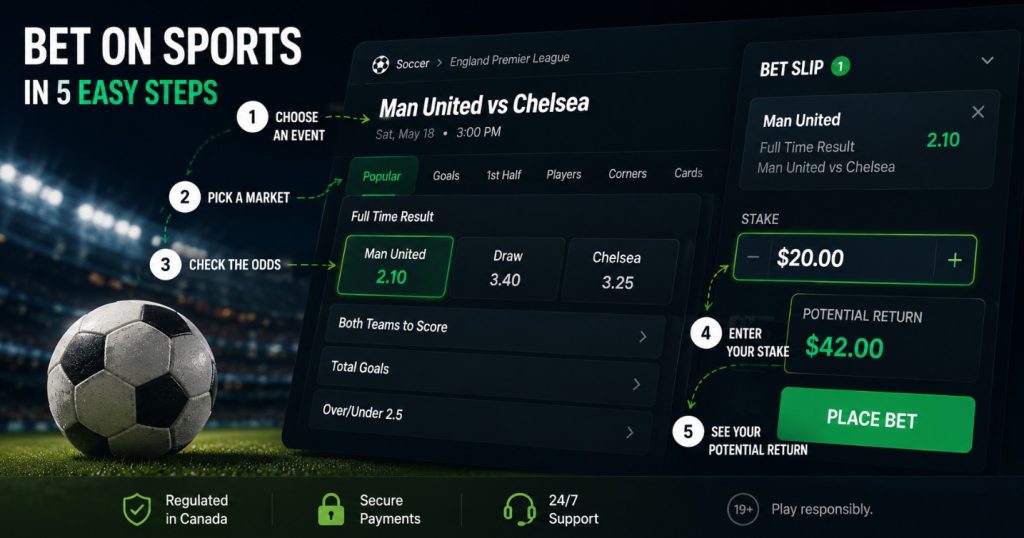
To bet on sports, Canadian beginners can open a sportsbook available in their province, select an event and market, add a selection to the bet slip, enter a stake, and confirm the wager.
Sports betting means putting money on a predicted outcome in a game or event. For a sports bettor, betting on sports involves selecting a market, reading its price, and understanding the outcome that settles the wager. The basic process is the same across most sportsbook apps and websites: select an event, open a market, choose an outcome, review the price, and place the wager.
Before you start: Betting should be conducted through a sportsbook that is permitted where you are located, after its age and identity requirements have been met.
🔤 Basic terms to know
The terms below appear on nearly every sportsbook screen. Knowing them makes the step-by-step process easier to follow.
A sportsbook is a website, app, or venue that accepts sports wagers. Example: an app displaying NHL betting markets.
Odds are the price attached to a selection and determine the potential return. Example: decimal odds of 2.00.
A stake is the amount placed on one wager. Example: a stake of $5.
A moneyline is a selection on the team or player to win. Example: Team A to win.
A spread is a selection on whether a team will cover a stated winning or losing margin. Example: Team A -4.5.
A total is a selection on whether the combined score will finish over or under a stated number. Example: over 6.5 goals.
A parlay combines two or more selections on one ticket; each selection normally needs to win. Example: two match winners combined on one ticket.
✅ How to bet on sports: step by step
The process below describes a typical single wager. Names and screen layouts vary slightly between sportsbooks, but the workflow is broadly consistent.
1️⃣ Choose an event
Sportsbooks list events by sport, league, date, and start time. Opening an event takes you to its betting page, where the available markets are shown.
The event page identifies the teams or players, scheduled start time, and market categories. It may also indicate whether the event is live, meaning that odds can update while play is underway.
The matchup identifies the teams or players taking part in the event.
The start time shows when the event is scheduled to begin.
Market tabs organize betting options into categories such as main markets, spreads, totals, player props, or period betting.
A live indicator shows that the event has already started.
2️⃣ Open a market
A market is the question the sportsbook is pricing. Selecting a market category opens the outcomes available for that question.
The most common markets are moneyline, point spread, and total. A moneyline concerns the winner. A point spread concerns the margin. A total concerns the combined score.
A moneyline asks which team or player will win. Example selection: Team A to win at 2.00.
A point spread asks whether a team will cover a stated winning or losing margin. Example selection: Team A -4.5 at 1.91.
A total asks whether the combined score will finish over or under a stated number. Example selection: over 6.5 at 1.90.
3️⃣ Add a selection to the bet slip
A selection is the outcome chosen within a market. Selecting an outcome—such as Team A on the moneyline—adds it to the bet slip, which is usually displayed at the side or bottom of the screen.
The bet slip lists the event, market, selection, odds, and stake field. It provides the information used to review the wager before it is submitted.
4️⃣ Enter the stake
The stake is the amount placed on the wager. When a stake is entered, the sportsbook calculates the potential return from the listed odds.
For example, a $5 stake at decimal odds of 2.00 has a potential return of $10. That return includes the original $5 stake, so the potential profit is $5.
5️⃣ Read the odds and potential payout
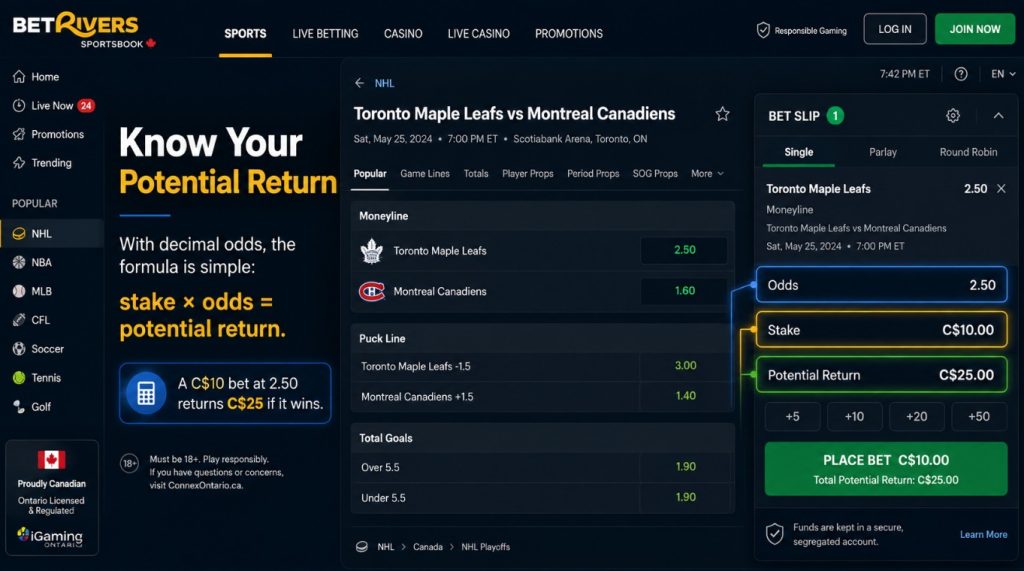
Odds are the price of a selection. Canadian sportsbooks commonly display decimal odds, which show the total return for each dollar staked.
Potential return = stake × decimal odds
The bet slip usually calculates the potential return automatically after a stake is entered. A selection priced at 1.50 has a lower potential return than one at 2.50 because it is priced as more likely to win.
| Stake | Decimal odds | Potential return | Potential profit |
| $5 | 2.00 | $10 | $5 |
| $10 | 1.50 | $15 | $5 |
| $10 | 2.50 | $25 | $15 |
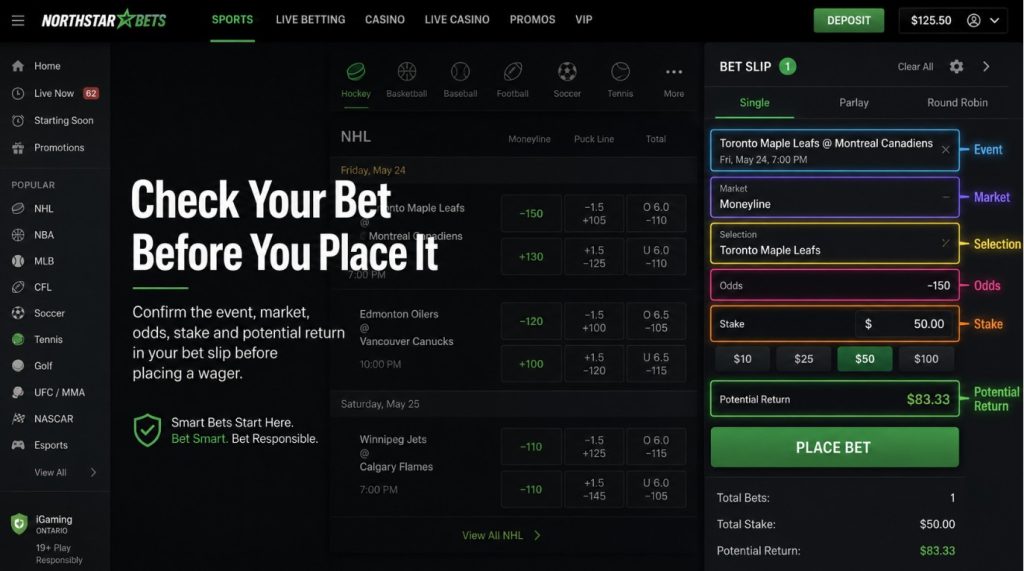
6️⃣ Review the bet slip and confirm the wager
The bet slip contains the final details of the wager:
- The event and scheduled start time.
- The market and exact selection.
- The current odds.
- The stake.
- The potential return.
The Place Bet, Confirm, or equivalent button submits the wager. After acceptance, the sportsbook normally provides a confirmation screen or ticket number. The wager then appears in a section such as My Bets, Open Bets, or Bet History.
7️⃣ Check the result after the event
An open bet has not yet been settled. When the event ends, the sportsbook marks the wager as a win, loss, push, or void according to the result and its settlement rules.
A push occurs when the outcome exactly matches a whole-number line. A void wager has its stake returned because the sportsbook’s event rules require cancellation or no action.
✔ Selecting a sportsbook
Account creation is subject to the sportsbook’s age requirements and its availability in your province. Its licence or regulatory status indicates whether the provider is authorized for that location. Readable odds, clear payment options, and an easy-to-use bet slip make the betting process easier to review.
🤗 Understanding the main bet types
The four market types below are the most common starting points. Each has a dedicated Bet University guide for readers who want a fuller explanation.
A moneyline bet is a selection on the team or player to win an event. Read the Bet University guide to moneyline betting.
A spread bet is a selection on whether a team will cover a stated winning or losing margin. Read the Bet University guide to spread betting.
A total, also called an over/under, is a selection on whether a combined score will finish above or below a stated number. Read the Bet University guide to totals betting.
A parlay combines two or more selections on one ticket; every selection normally needs to win. Read the Bet University guide to parlay betting.
📈 How to read a betting line
A line is the number attached to a spread or total. It states the condition that must be met, so the team name alone does not define the wager. A betting line can be read in three parts:
- Market name: moneyline, spread, total, period market, or player prop.
- Line: for example, -3.5, +3.5, over 47.5, or under 47.5.
- Odds beside the selection: the price that determines the potential return.
For example, “Toronto -3.5 at 1.91” means Toronto must win by at least four points. A $10 stake at 1.91 has a potential return of $19.10. It does not mean Toronto simply needs to win the game.
🔍 Details to check before confirming a bet
| Detail | Why it matters |
| Market label | It identifies whether the selection is a moneyline, spread, total, or period bet. |
| Line | It states the score, margin, or statistic needed for the selection to win. |
| Current odds | Odds determine the potential return and can update before confirmation. |
| Stake and return | The return includes the original stake; profit is the return minus that stake. |
| Settlement rules | These explain how overtime, postponements, and player changes are handled. |
| Parlay structure | Each selection normally needs to win, so the ticket depends on multiple outcomes. |
😉 Quick checklist before placing a bet
- Legal and eligible sportsbook: Confirm that the sportsbook is available and authorized for the location, and that its account requirements have been met.
- Market understood: Identify the market, selection, and condition that determines the result.
- Odds, stake, and payout checked: Review the current odds, the stake, and the potential return shown in the bet slip.
- Bet details and responsible gambling check: Confirm the event, market, selection, and start time; the stake should remain within the bankroll allocated for betting.
📚 A worked example
This example follows one wager from the event page to the potential return.
| Step | Example |
| Event | Team A vs. Team B hockey game |
| Market | Team A moneyline |
| Odds | 2.00 decimal odds |
| Stake | $5 |
| Potential return | $10 if Team A wins |
The calculation is $5 × 2.00 = $10. The $10 potential return includes the original $5 stake.
🛡️ Bankroll and responsible gambling
A bankroll is the total amount allocated to betting and is separate from money needed for everyday expenses. It sets the overall budget and the amount available for individual stakes. Chasing losses means increasing or adding wagers in response to earlier losses; it increases the total amount at risk. Sportsbooks may offer deposit limits, time-outs, or self-exclusion tools. Canadian support and information are available through the Lower-Risk Gambling Guidelines and the Responsible Gambling Council.



- Casino of games and sports betting
- Generous bonuses and promotions
- Security measures and fair play

- Hundreds of slots, table games
- Welcome bonus and reload bonuses
- Mobile app and mobile website

100% up to C$500
- Groovy bonuses and inducements
- Dedicated VIP program
- Multiple payment methods

100% up to $750 + 200 FS


- Over 4000 casino games
- 25+ sports, with live streaming
- Great range of payment options

100% up to 5 BTC

- Sportsbook with 35+ sports
- Ongoing and reload promotions
- Industry competitive odds


- Library of slots, table games
- Attractive welcome bonuses
- Program with exclusive benefits

Bonus 100% up to C$500
- Extensive game selection
- Welcome bonuses and promotions
- Comprehensive VIP program




Bonus 100% up to C$500
- Games from top-tier providers
- Welcome bonuses and promotions
- Dedicated apps for iOS and Android

Bonus 100% up to C$250
- A vast selection of games
- Attractive bonuses and promotions
- A variety of banking methods


What Is the Legal Betting Age in Canada?
The legal betting age in Canada is 18 or 19 depending on the province, territory and, in some cases, whether the bet is placed online or through a retail product. Alberta, Manitoba and Quebec generally allow regulated sports betting from age 18, while most other Canadian jurisdictions require bettors to be 19. Ontario is the […]

What Is Line Movement?
Line movement is a change in the odds, point spread or total offered by a sportsbook after a betting market has opened. For Canadian bettors, it shows how the market price changes as new information, betting activity or sportsbook adjustments affect the original line. For example, if the Toronto Maple Leafs open at 2.10 and […]

What Is +EV Betting?
+EV betting means placing a wager with a positive expected value, where the bettor believes the potential payout is high enough relative to the probability of winning to produce a theoretical long-term profit. For Canadian bettors, this means evaluating both the sportsbook price and an estimated probability rather than looking only at which team is […]

What Is Value Betting?
Value betting means placing a wager when the odds offered by a sportsbook are higher than the bettor believes the true probability of that outcome justifies. For Canadian bettors, this means comparing the sportsbook’s decimal odds with an estimated fair price rather than simply choosing the team or player most likely to win. For anyone […]