

To calculate betting payouts in Canada, multiply your stake by the applicable odds to determine the total return, then subtract your original stake to find your profit. For example, a C$20 bet at decimal odds of 2.50 returns C$50 if it wins: C$30 profit plus the original C$20 stake. Your stake is the amount risked; profit or winnings is the amount made above it; and the total payout or return combines both.
The essential rule: total payout is the full amount returned on a winning bet; it is not automatically the same as profit.
🔢 How Do You Calculate a Betting Payout?
For decimal odds, use the total-return formula first, then remove the stake to find profit:
Total payout = Stake × Decimal odds
Profit = Total payout − Stake
A C$20 wager at 2.50 gives a C$50 total payout: `C$20 × 2.50 = C$50`. Subtracting the C$20 stake leaves C$30 profit. In other words, a C$50 payout does not mean C$50 was earned; the original C$20 is included. OLG describes decimal odds in the same way: they show the total payout, including stake, per C$1 wagered.
| Stake | Decimal odds | Profit | Total payout |
|---|---|---|---|
| C$10 | 2.50 | C$15 | C$25 |
| C$20 | 2.50 | C$30 | C$50 |
| C$50 | 2.50 | C$75 | C$125 |
| C$100 | 2.50 | C$150 | C$250 |
📊 What Is the Difference Between Payout, Profit and Stake?
To avoid an incorrect betting payout calculation, label each amount before doing the maths. With a C$20 stake at 2.50, the stake is C$20, the potential profit is C$30, and the total payout is C$50.
Total payout = Stake + Profit
Sportsbooks may label figures differently, so check whether the displayed amount includes the stake. Decimal odds normally show total return; the final bet-slip return is the figure to verify.
➡️ How to Calculate Payouts with Decimal Odds
To calculate a betting payout with decimal odds, multiply the stake by the decimal price. You can also calculate profit directly by taking the stake times the odds minus one.
Total payout = Stake × Decimal odds
Profit = Stake × (Decimal odds − 1)
Example 1: C$20 at 1.50 returns C$30, including C$10 profit. Example 2: C$20 at 2.50 returns C$50, including C$30 profit. Example 3: C$50 at 4.00 returns C$200, including C$150 profit.
Decimal prices include stake: 1.50 returns C$1.50 per C$1, while 4.00 returns C$4.00.
➡️ How to Calculate Payouts with Positive American Odds
To calculate betting winnings from positive American odds, multiply the stake by the quoted number divided by 100, then add the stake back.
Profit = Stake × (Positive American odds ÷ 100)
Total payout = Stake + Profit
For a C$20 bet at +150, profit is `C$20 × (150 ÷ 100) = C$30`. The total payout is `C$20 + C$30 = C$50`. Put simply, +150 means a C$100 winning stake would generate C$150 profit. It does not require a C$100 stake; the sports betting payout scales proportionally with the amount entered.
➡️ How to Calculate Payouts with Negative American Odds
To calculate a betting payout at negative American odds, divide 100 by the absolute value of the odds, multiply by the stake, and then add the stake.
Profit = Stake × (100 ÷ Absolute value of odds)
Total payout = Stake + Profit
For a C$20 bet at −150, profit is `C$20 × (100 ÷ 150) = C$13.33` after rounding. The total payout is `C$20 + C$13.33 = C$33.33`. −150 does not mean a negative payout. It means the standard quote uses C$150 staked to make C$100 profit. OLG likewise explains negative American odds as the amount required to wager for C$100 profit.
➡️ How to Calculate Payouts with Fractional Odds
To calculate potential payout from fractional odds, first calculate profit from the fraction, then add the stake.
Profit = Stake × (Numerator ÷ Denominator)
Total payout = Stake + Profit
For C$20 at 3/2, profit is `C$20 × (3 ÷ 2) = C$30`, and total payout is C$50. The same price can be written as 3/2 fractional = 2.50 decimal = +150 American. The format changes, but the payout does not when the odds are equivalent.
📈 Betting Payout Examples: Decimal vs American vs Fractional
Equivalent odds deliver the same return; the final two rows illustrate negative-price equivalents.
| Odds format | Odds | Stake | Profit |
|---|---|---|---|
| Decimal | 2.50 | C$20 | C$30.00 |
| American | +150 | C$20 | C$30.00 |
| Fractional | 3/2 | C$20 | C$30.00 |
| Decimal | 1.67 | C$20 | C$13.40 |
| American | -150 | C$20 | C$13.33 |
A small difference can occur because 1.67 is a rounded display of a decimal price, whereas the exact American conversion from −150 is 1.666…. Use the accepted odds and the operator’s displayed payout for the final figure.
📌 How to Calculate a Parlay Payout
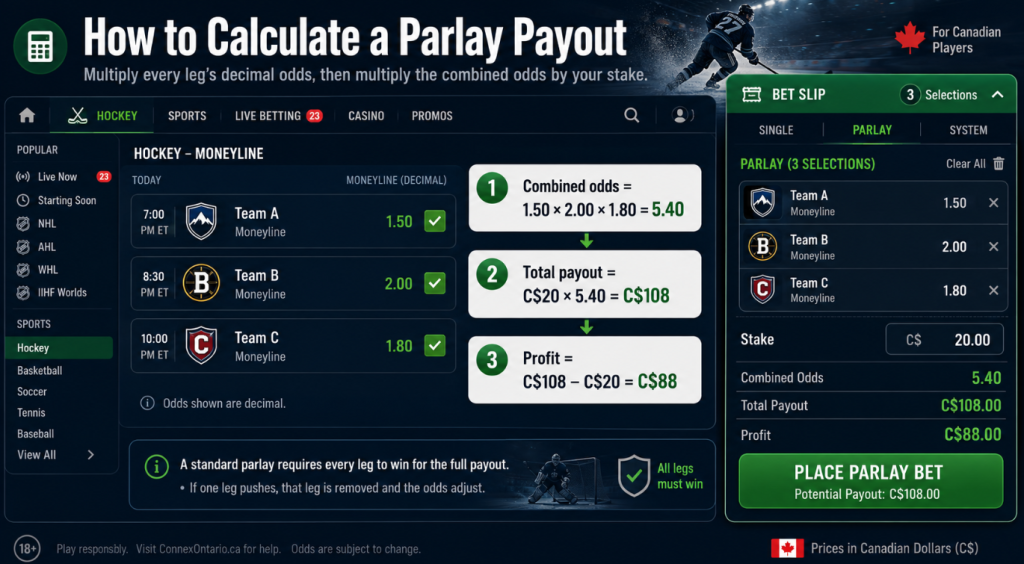
To calculate a parlay payout with decimal odds, multiply every leg’s decimal price, then multiply the combined odds by the stake.
Combined odds = Odd 1 × Odd 2 × Odd 3
Total payout = Stake × Combined odds
For a hypothetical C$20 parlay with Team A at 1.50, Team B at 2.00, and Team C at 1.80, the combined odds are `1.50 × 2.00 × 1.80 = 5.40`. The total payout is `C$20 × 5.40 = C$108`, leaving C$88 profit. A standard parlay requires every leg to win for the full payout. OLG also calculates parlay odds by multiplying decimal odds; if a leg pushes, it says that leg is removed and the odds adjust.
👉 How Does a Push or Void Bet Affect the Payout?
A push on a single bet generally returns the stake. Void treatment varies by market, bet type, and operator; in an OLG parlay, a pushed leg is removed and odds adjust. Check the sportsbook’s settlement rules.
🤔 How Do Sportsbooks Calculate Your Final Payout?
Use accepted odds on the bet slip, not an earlier market price. Prices can move before confirmation, particularly live. AGCO Internet Gaming Standards 2.15.1–2.15.2 require available-bet odds, payouts, and prices without placement. If odds, payout odds, or prices change before confirmation, the player must have an option to confirm or withdraw; all bets and payouts must be in Canadian currency.
😉 Common Betting Payout Calculation Mistakes
The most common error is confusing profit with total payout: C$20 at 2.50 returns C$50, but only C$30 is profit. A second mistake is subtracting the stake twice from a decimal calculation, even though decimal odds already include it. Third, +150 is not a fixed C$150 payout; it means C$150 profit per C$100 staked. Fourth, −150 is not a loss or negative return—it is a risk-to-win reference. Fifth, decimal parlay odds must be multiplied, not added. Finally, exact returns can differ by a few cents when a displayed price is rounded or when the accepted price has changed.
🤖 Quick Betting Payout Formula Cheat Sheet
| Odds type | Profit formula | Total-payout formula | |
|---|---|---|---|
| Decimal | Stake x (Odds-1) | Stake x Odds | |
| Positive American | Stake x (Odds ÷ 100) | Stake + Profit | |
| Negative American | Stake x (100 ÷ |Odds|) | Stake + Profit | |
| Fractional | Stake x (Numerator ÷ Denominator) | Stake + Profit | |
| Decimal parlay | Calculare combined odds first | Stake x(Odd1 x Odd2 x…) |
❓ FAQ
Multiply your stake by decimal odds to find the total payout, then subtract the stake for profit. For American or fractional odds, calculate profit using the relevant formula and add your stake. The calculation should be based on the odds accepted on your bet slip, because displayed prices can change before acceptance.
A C$20 bet at decimal odds of 2.00 pays C$40 in total if it wins. That return contains C$20 profit and the returned C$20 stake. Decimal odds of 2.00 are also called even money because the potential profit equals the amount staked.
A C$100 bet at +150 makes C$150 profit if it wins. Add the returned C$100 stake, and the total payout is C$250. For any other stake, multiply the amount staked by 1.5 to calculate profit, then add the stake.
A C$100 bet at −150 makes approximately C$66.67 profit: `C$100 × (100 ÷ 150)`. Adding the original stake gives an approximate total payout of C$166.67. The final amount may be rounded according to the operator’s payout rules.
Usually, a total payout or total return includes the original stake, but the layout can vary by sportsbook. With decimal odds, the standard multiplication gives total return directly. Always check whether a page labels a figure as *profit*, *to win*, or *total payout* before interpreting it.
Convert every parlay leg to decimal odds if needed, multiply those prices to get combined odds, and multiply the result by your stake. For example, C$20 at combined odds of 5.40 returns C$108 in total and C$88 in profit. A standard parlay needs all legs to win for the full payout.
The difference may come from a rounded display price, the exact odds accepted when the wager was confirmed, or the operator’s settlement and rounding rules. Treat the accepted bet-slip price and displayed total return as the operative record. Under AGCO Internet Gaming Standard 2.15.1, a player must be able to confirm or withdraw when odds, payout odds, or prices change before operator confirmation.
No. Profit is the amount earned above the stake, while payout is the full winning return. A C$20 bet at 2.50 has C$30 profit but a C$50 total payout, because the C$20 original stake is included in the return.



- Casino of games and sports betting
- Generous bonuses and promotions
- Security measures and fair play

- Hundreds of slots, table games
- Welcome bonus and reload bonuses
- Mobile app and mobile website

100% up to C$500
- Groovy bonuses and inducements
- Dedicated VIP program
- Multiple payment methods

100% up to $750 + 200 FS


- Over 4000 casino games
- 25+ sports, with live streaming
- Great range of payment options

100% up to 5 BTC

- Sportsbook with 35+ sports
- Ongoing and reload promotions
- Industry competitive odds


- Library of slots, table games
- Attractive welcome bonuses
- Program with exclusive benefits

Bonus 100% up to C$500
- Extensive game selection
- Welcome bonuses and promotions
- Comprehensive VIP program




Bonus 100% up to C$500
- Games from top-tier providers
- Welcome bonuses and promotions
- Dedicated apps for iOS and Android

Bonus 100% up to C$250
- A vast selection of games
- Attractive bonuses and promotions
- A variety of banking methods


What Is the Legal Betting Age in Canada?
The legal betting age in Canada is 18 or 19 depending on the province, territory and, in some cases, whether the bet is placed online or through a retail product. Alberta, Manitoba and Quebec generally allow regulated sports betting from age 18, while most other Canadian jurisdictions require bettors to be 19. Ontario is the […]

What Is Line Movement?
Line movement is a change in the odds, point spread or total offered by a sportsbook after a betting market has opened. For Canadian bettors, it shows how the market price changes as new information, betting activity or sportsbook adjustments affect the original line. For example, if the Toronto Maple Leafs open at 2.10 and […]

What Is +EV Betting?
+EV betting means placing a wager with a positive expected value, where the bettor believes the potential payout is high enough relative to the probability of winning to produce a theoretical long-term profit. For Canadian bettors, this means evaluating both the sportsbook price and an estimated probability rather than looking only at which team is […]

What Is Value Betting?
Value betting means placing a wager when the odds offered by a sportsbook are higher than the bettor believes the true probability of that outcome justifies. For Canadian bettors, this means comparing the sportsbook’s decimal odds with an estimated fair price rather than simply choosing the team or player most likely to win. For anyone […]